Rash Nature Pokemon: Full Trainer Guide for Smart Battles
If you have ever looked at your pokemon’s summary screen and noticed the word “Rash,” you might have wondered whether it helps or hurts. A rash nature pokemon boosts one key offensive stat while leaving a defensive stat lower than usual. For the right pokemon on the right team, this trade-off pays off well. This guide explains exactly how a rash nature pokemon functions, which species benefit most, how it compares to similar natures, and whether it deserves a spot in your current team build.
What Does Rash Nature Do in Pokemon?
A rash nature pokemon receives a 10% increase to Special Attack and a 10% reduction to Special Defense. That is the full extent of its stat modification. Every other stat, including Attack, Defense, Speed, and HP, stays at the standard 1.0 multiplier with no change at all.
This makes the rash nature pokemon a straightforward choice: it trades some durability against special moves in exchange for stronger special attacks. Whether that is a good deal depends entirely on what role you need your pokemon to fill.
For comparison, the breakdown at serious nature pokemon best picks covers how a neutral nature handles the same stat pool differently, which is useful context when deciding between the two.
How Rash Nature Fits into the Nature System
Pokemon natures fall into two categories. Neutral natures apply no change to any stat. Non-neutral natures raise one stat by 10% and lower a different stat by 10%. Rash belongs to the non-neutral group, paired with Special Attack as the boosted stat and Special Defense as the lowered stat.
There are four natures that boost Special Attack:
- Modest: raises Special Attack, lowers Attack
- Mild: raises Special Attack, lowers Defense
- Rash: raises Special Attack, lowers Special Defense
- Quiet: raises Special Attack, lowers Speed
Each one sacrifices something different to gain the same Special Attack boost. A rash nature pokemon gives up Special Defense specifically, which matters a lot in battles where your opponent uses special moves.
According to Bulbapedia, natures were introduced in Generation III and have been a core part of competitive team building ever since. Understanding where rash sits within that system is the first step to using it well.
Which Pokemon Benefit Most from Rash Nature?
The best candidates for a rash nature pokemon share a few common traits.
High Special Attack, Low Special Defense Base Stats
Pokemon that already have strong Special Attack stats get the most value from rash’s 10% boost. For these species, the Special Defense loss is less painful because their defensive role was never their strength to begin with.
If a pokemon already has low Special Defense as a base stat, the rash nature reduction matters less in practice. A fast, hard-hitting special attacker that faints in one or two hits anyway does not gain much from having higher Special Defense.
Mixed Attackers
A rash nature pokemon can work well on pokemon that use both physical and special moves. Since rash only lowers Special Defense and not Attack, mixed attackers keep their physical damage output intact while gaining a Special Attack bonus. This is the key advantage rash has over Modest nature, which cuts Attack directly.
Pokemon That Do Not Fear Special Hits
In team compositions where the rash nature pokemon is protected by a partner or used in a one-hit offense role, the Special Defense drop rarely becomes a deciding factor. Trick Room teams and hyper-offense builds often fall into this category.

Rash Nature vs. Modest Nature: Which Should You Choose?
This is the most common question trainers ask when considering a rash nature pokemon for their team.
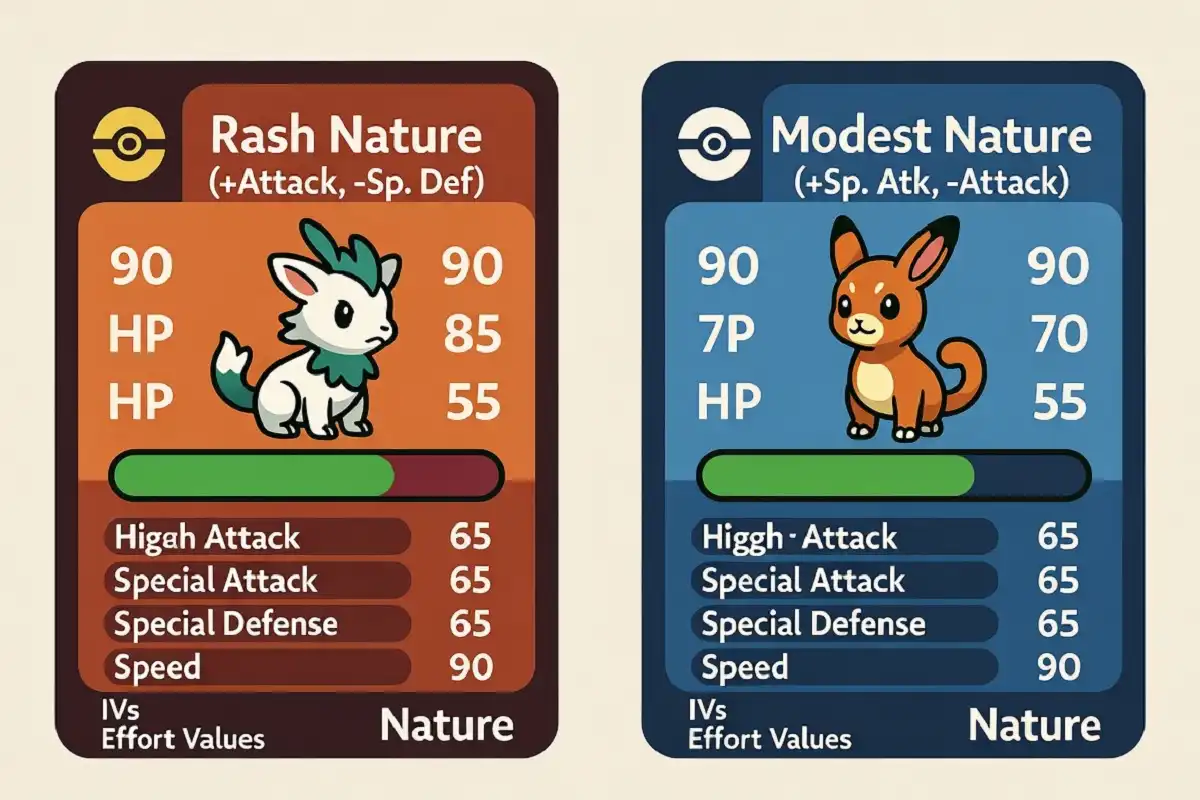
Both rash and Modest raise Special Attack by the same 10%. The difference is what each one lowers:
- Modest lowers Attack
- Rash lowers Special Defense
For a pure special attacker that never uses physical moves, Modest is usually the cleaner choice. It preserves Special Defense, which keeps the pokemon harder to knock out with special hits.
For a mixed attacker that uses both physical and special moves, a rash nature pokemon can outperform Modest. Lowering Attack on a pokemon that actively uses physical moves is a direct damage penalty. Rash avoids that problem entirely.
The guide on calm nature pokemon best picks explores a similar trade-off from the Special Defense perspective, and is worth reading if you are deciding between offensive and defensive nature setups.
Rash Nature in Competitive Play
In ranked and tournament play, the rash nature pokemon appears most often on mixed attackers, trick room teams, and situations where the trainer specifically values keeping physical damage output intact.
Because competitive matches often come down to single-turn outcomes, the Special Attack boost from rash can make the difference between a 2HKO and an OHKO on a key target. At the same time, the lowered Special Defense means the rash nature pokemon can be revenge-killed more easily by opponents running special moves.
For this reason, most competitive players using a rash nature pokemon pair it with a teammate that covers its Special Defense weakness, such as a Assault Vest holder or a fast pivot that can absorb incoming special hits.
For trainers exploring the strategic patience required in competitive team building, the mindset parallels covered at productivity nature boost translate surprisingly well to how top players think through matchup preparation.
Can You Change a Rash Nature Pokemon?
Yes. Since Pokemon Sword and Shield, Mints allow trainers to override a pokemon’s nature effect without changing the label on the summary screen.
If you have a rash nature pokemon but want a different stat modification, applying the relevant Mint adjusts the stat effect going forward. The nature still reads “Rash” on the summary page, but the modified stat effect from the Mint takes over in calculations.
According to the official Pokemon website, items like Mints and the Everstone give trainers more control over nature mechanics than was possible in earlier generations, making it easier to optimize a rash nature pokemon or any other pokemon without starting the breeding process over from scratch.
If you prefer to breed naturally for the right nature, holding an Everstone passes the holder’s nature to offspring. This is useful when you want to deliberately produce a rash nature pokemon across multiple breeding attempts.
For trainers who enjoy exploring nature-inspired strategy in other parts of life, gentle nature pokemon full guide and docile nature pokemon offer solid reads on how different nature philosophies shape team builds.

FAQs
What stats does rash nature affect?
A rash nature pokemon gains a 10% boost to Special Attack and takes a 10% reduction to Special Defense. All other stats remain at their standard base values with no modification.
Is rash nature good for competitive play?
Yes, a rash nature pokemon can be effective in competitive play, particularly on mixed attackers or in formats where Speed is not a priority. It works best when the Special Defense drop does not expose the pokemon to being quickly eliminated by special moves.
What is the difference between rash and mild nature?
Both rash and mild raise Special Attack by 10%. Mild lowers Defense, while rash lowers Special Defense. A rash nature pokemon is more vulnerable to special hits, while a mild nature pokemon is more vulnerable to physical hits.
Can I fix a rash nature pokemon using a mint?
Yes. Applying any mint to a rash nature pokemon overrides the stat modification with the mint’s effect. The summary screen still shows Rash, but the stat calculation uses the mint’s nature instead.
Which types of moves benefit from rash nature?
Special moves, such as Flamethrower, Ice Beam, Thunderbolt, Surf, and Psychic, benefit directly from the Special Attack boost a rash nature pokemon receives. Physical moves are unaffected since rash does not raise or lower Attack.
Conclusion
A rash nature pokemon offers a clear and focused trade: stronger special moves in exchange for reduced special bulk. For mixed attackers, hyper-offense builds, and pokemon that already lack Special Defense, this trade is often worth making. For pure special attackers that need to survive hits, Modest may serve better. The key is matching the nature to the pokemon’s role, not treating any single nature as universally good or bad.