Pokemon Nature Chart: Complete Guide to All 25 Natures
Introduction: Why the Pokemon Nature Chart Changes Everything
If you have ever wondered why two Pokemon of the exact same species with identical moves perform completely differently in battle, the answer almost always comes down to one word — nature. The Pokemon nature chart is one of the most powerful and often misunderstood mechanics in the entire franchise. Whether you are a casual player just starting to dig into the deeper systems or a veteran trainer building your first competitive team, understanding the Pokemon nature chart is absolutely essential.
Natures were introduced back in Generation III with Pokemon Ruby and Sapphire, and they have been a core mechanic ever since. Every single Pokemon in the games has one nature out of a possible 25, and most of those natures permanently shape how a Pokemon’s stats develop as it levels up. We are talking about a 10% increase to one stat and a 10% decrease to another — which at level 100 can translate to a difference of 20 to 30+ stat points depending on the base stat value involved.
That gap might not sound like much on paper, but in competitive battles, it is the difference between outspeeding a threat, surviving a hit that should have knocked you out, or crossing a critical damage threshold. The Pokemon nature chart is not optional knowledge for serious trainers — it is the foundation of building any effective team.
In this complete guide, we are going to walk through every single one of the 25 natures, explain what they do to your Pokemon’s stats, cover the best natures for different battle roles, and give you practical strategies for getting the nature you want through breeding and items like Nature Mints. By the end of this article, you will have everything you need to use the Pokemon nature chart like a professional.
What Is the Pokemon Nature Chart?
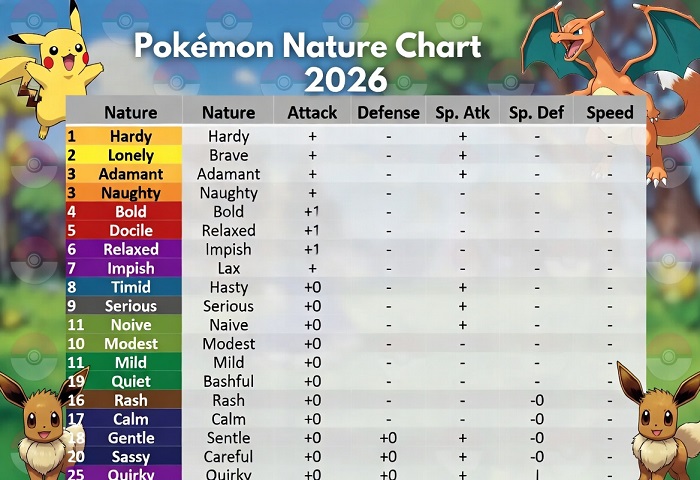
The Pokemon nature chart is a reference that maps all 25 available Pokemon natures to their corresponding stat increases and decreases. Think of it as a 5×5 grid where rows represent the stat that gets boosted and columns represent the stat that gets reduced. Each unique combination in that grid corresponds to one named nature.
Here is the core mechanic you need to understand: most natures raise one stat by 10% and lower a different stat by 10%. The five stats that can be affected are Attack, Defense, Special Attack, Special Defense, and Speed. Importantly, HP is never affected by nature — it always grows at a neutral rate regardless of what nature your Pokemon has.
The five neutral natures — Hardy, Docile, Serious, Bashful, and Quirky — are special cases. Technically they do boost and reduce a stat, but it is the same stat both times, so the effects cancel out completely. A Pokemon with one of these neutral natures grows all of its stats at the standard baseline rate. They are generally not recommended for competitive play because you are essentially giving up a free 10% boost in exchange for nothing.
Since Generation VIII (Sword and Shield), you can identify a Pokemon’s nature effects at a glance on its stat screen. The stat receiving the 10% boost is highlighted in red, and the stat being reduced by 10% is highlighted in blue. This color-coded system makes consulting the Pokemon nature chart in-game much easier than in older titles where you had to memorize everything yourself.
All 25 Natures: The Complete Pokemon Nature Chart
Below is the full Pokemon nature chart with every nature listed alongside the stat it boosts, the stat it lowers, and the flavor preference each nature gives your Pokemon.
Natures That Boost Attack
| Nature | Stat Raised | Stat Lowered | Liked Flavor | Disliked Flavor |
|---|---|---|---|---|
| Adamant | Attack | Special Attack | Spicy | Dry |
| Naughty | Attack | Special Defense | Spicy | Bitter |
| Brave | Attack | Speed | Spicy | Sweet |
| Lonely | Attack | Defense | Spicy | Sour |
| Hardy | Attack | Attack (Neutral) | Spicy | Spicy |
Natures That Boost Defense
| Nature | Stat Raised | Stat Lowered | Liked Flavor | Disliked Flavor |
|---|---|---|---|---|
| Bold | Defense | Attack | Sour | Spicy |
| Impish | Defense | Special Attack | Sour | Dry |
| Lax | Defense | Special Defense | Sour | Bitter |
| Relaxed | Defense | Speed | Sour | Sweet |
| Docile | Defense | Defense (Neutral) | Sour | Sour |
Natures That Boost Special Attack
| Nature | Stat Raised | Stat Lowered | Liked Flavor | Disliked Flavor |
|---|---|---|---|---|
| Modest | Special Attack | Attack | Dry | Spicy |
| Mild | Special Attack | Defense | Dry | Sour |
| Rash | Special Attack | Sp. Defense | Dry | Bitter |
| Quiet | Special Attack | Speed | Dry | Sweet |
| Bashful | Sp. Atk (Neutral) | Sp. Atk | Dry | Dry |
Natures That Boost Special Defense
| Nature | Stat Raised | Stat Lowered | Liked Flavor | Disliked Flavor |
|---|---|---|---|---|
| Calm | Special Defense | Attack | Bitter | Spicy |
| Gentle | Special Defense | Defense | Bitter | Sour |
| Careful | Special Defense | Special Attack | Bitter | Dry |
| Sassy | Special Defense | Speed | Bitter | Sweet |
| Quirky | Sp. Def (Neutral) | Sp. Def | Bitter | Bitter |
Natures That Boost Speed
| Nature | Stat Raised | Stat Lowered | Liked Flavor | Disliked Flavor |
|---|---|---|---|---|
| Timid | Speed | Attack | Sweet | Spicy |
| Hasty | Speed | Defense | Sweet | Sour |
| Jolly | Speed | Special Attack | Sweet | Dry |
| Naive | Speed | Special Defense | Sweet | Bitter |
| Serious | Speed (Neutral) | Speed | Sweet | Sweet |
Understanding Stat Impact at Level 100
One of the most practical things to understand when using the Pokemon nature chart is exactly how much difference a nature actually makes in real numbers. The answer depends on the Pokemon’s base stat value.
The formula is straightforward: a nature multiplies the final stat by 1.1 (for the boosted stat) or 0.9 (for the reduced stat). At level 100, with average IVs and EVs considered, a nature can create a swing of roughly 20% between the boosted and reduced versions of the same stat.
For a practical example, consider a Pokemon with 150 base Special Attack like Gengar. At level 100 with 31 IVs and 252 EVs, a Modest nature would push that Special Attack to around 359, while a nature that penalizes Special Attack drops it to around 295. That is a 64-point difference — enough to completely change which Pokemon you can one-shot in battle.
Speed is particularly sensitive to natures because of how speed ties work. If your Pokemon sits at 299 Speed with a neutral nature and a key threat has 300, you always lose the speed tie and always move second. Adding a Timid or Jolly nature to push past 330 can fundamentally change how a Pokemon performs in an entire meta.
This is why players consult the Pokemon nature chart before building any serious competitive set. The right nature is not a minor optimization — it is a structural decision.
Best Natures by Battle Role
Understanding the full Pokemon nature chart is useful, but knowing which natures to actually use for each battle role is what separates good trainers from great ones. Here is a breakdown of the best natures by role.
Best Natures for Physical Attackers
Physical attackers rely on the Attack stat to deal damage. The two most popular natures for this role are Adamant and Jolly.
Adamant (+Attack, -Special Attack) is the go-to choice when you want to maximize raw damage output. Since physical attackers rarely use Special Attack moves, lowering it costs you nothing meaningful. Adamant is ideal for heavy-hitting attackers that do not need to win speed ties — think Dragonite, Garchomp, or Azumarill.
Jolly (+Speed, -Special Attack) trades a small amount of power for an important speed advantage. Jolly is the better choice when your Pokemon needs to outspeed specific threats in the meta. If the difference between going first and second determines whether you win or lose the matchup, Jolly beats Adamant every time.
For Trick Room teams where you want your Pokemon to move last (since Trick Room reverses the Speed order), Brave (+Attack, -Speed) is the optimal choice.
Best Natures for Special Attackers
Special attackers depend on Special Attack for their damage output. The mirror scenario to physical attackers applies here.
Modest (+Special Attack, -Attack) maximizes Special Attack while sacrificing the Attack stat that special-only attackers never use. Modest is preferred for Pokemon that have high base Special Attack and do not need to win speed ties to function — Chandelure, Primarina, and Hydreigon are examples.
Timid (+Speed, -Attack) is the choice for special sweepers that need to move before the opponent. Timid reduces Attack instead of Special Attack, making it safe for Pokemon that rely entirely on special moves. Alakazam, Gengar, and Tapu Koko typically want Timid.
Best Natures for Physical Walls and Tanks
Physical walls want to take as many hits as possible. The key principle here is to lower whichever offensive stat the wall does not use.
Bold (+Defense, -Attack) is ideal for pure physical walls that carry zero physical moves. Blissey, Skarmory, and physically defensive Toxapex all benefit from Bold.
Impish (+Defense, -Special Attack) suits defensive Pokemon that still want to run at least one physical move in their set. Impish is commonly seen on Ferrothorn, Landorus-Therian, and Corviknight.
Best Natures for Special Walls
Special tanks need Special Defense to absorb special hits over and over.
Calm (+Special Defense, -Attack) is the standard for special tanks with no physical moves. Chansey, Blissey, and Clefable are textbook Calm users.
Careful (+Special Defense, -Special Attack) fits defensive Pokemon that still use physical moves for coverage or chip damage. Snorlax and Umbreon frequently run Careful.
Best Natures for Trick Room Teams
Trick Room flips the Speed order, meaning the slowest Pokemon moves first. For Trick Room sweepers, you want to minimize Speed as much as possible.
Brave (+Attack, -Speed) is used for Trick Room physical attackers. Quiet (+Special Attack, -Speed) is used for Trick Room special attackers. Relaxed (+Defense, -Speed) is used for Trick Room tanks. Sassy (+Special Defense, -Speed) is used for special-oriented Trick Room walls.
How to Get the Right Nature: Breeding, Everstone, and Synchronize
Knowing the Pokemon nature chart is only half the battle — you also need to know how to actually get the nature you want on a Pokemon.
Using the Everstone
The Everstone is your most reliable tool for nature breeding. When a parent Pokemon holds an Everstone during breeding in the Daycare or Picnic basket, it will pass its nature down to the egg. Starting in Generation V, this is 100% guaranteed from either the male or female parent — whichever one holds the Everstone will always pass its nature to the offspring.
The practical workflow is simple: catch or obtain a Pokemon with the nature you want, have it hold the Everstone, and breed it with the Pokemon whose species you are trying to raise. Every egg you hatch will have the correct nature, letting you focus on hunting for perfect IVs or other traits.
Using Synchronize
Synchronize is an ability that, when held by the lead Pokemon in your party, gives a 50% chance of wild Pokemon having the same nature as your lead. This is extremely useful for catching specific Pokemon in the wild with the right nature without having to breed them.
Ralts, Umbreon, and Espeon are popular Synchronize users because they are relatively easy to obtain in most games and come in a wide variety of natures. To use this method efficiently, breed a box full of Ralts or Abra with different natures, then lead with the one matching the nature you want when hunting specific wild Pokemon.
Using Nature Mints
Nature Mints were introduced in Pokemon Sword and Shield and represent the most modern and user-friendly solution to nature problems. A Nature Mint changes the stat effects of a Pokemon’s nature to match the mint used — without actually changing the Pokemon’s underlying nature for breeding purposes.
For example, if you have a Timid Gengar but want it to behave like a Modest Gengar in battle, you simply use a Modest Mint on it. From that point forward, the game applies the Modest stat modifiers (+Special Attack, -Attack) to the Pokemon even though its nature still reads “Timid.” Flavor preferences and breeding inheritance are unaffected.
In Pokemon Scarlet and Violet, Nature Mints are available for purchase at Chansey Supply stores for 20,000 Pokedollars each, making it straightforward to fix a Pokemon’s nature in the post-game without having to breed fresh eggs.
Pokemon Nature Chart and Flavor Preferences
One enjoyable layer of the Pokemon nature chart that often goes overlooked is the flavor system. Each nature corresponds to a liked flavor and a disliked flavor, which affects how a Pokemon responds to Poffins (in older games), berries, and even sandwiches in Scarlet and Violet.
The five flavors — Spicy, Dry, Sweet, Sour, and Bitter — each correspond to a stat. Spicy connects to Attack, Sour to Defense, Dry to Special Attack, Bitter to Special Defense, and Sweet to Speed.
A Pokemon’s liked flavor always corresponds to its boosted stat, and its disliked flavor matches its reduced stat. So an Adamant Pokemon (which boosts Attack and lowers Special Attack) loves Spicy flavors and dislikes Dry ones. A Timid Pokemon (boosting Speed, lowering Attack) enjoys Sweet flavors and dislikes Spicy.
In Scarlet and Violet, making sandwiches with your Pokemon’s preferred flavor can provide meaningful battle bonuses during Tera Raids and other content, making it worthwhile to know your team’s nature-flavor matchups from the Pokemon nature chart.
Neutral Natures: When Should You Use Them?
The five neutral natures — Hardy, Docile, Serious, Bashful, and Quirky — are generally considered suboptimal for competitive play. Because they increase and decrease the same stat, their effects cancel out completely, leaving your Pokemon with no net bonus anywhere.
In casual play, neutral natures are perfectly fine. You can complete the main story of any Pokemon game with any nature without ever noticing a meaningful difference in difficulty. The neutral natures only start to matter — in a negative sense — when you step into post-game competitive content, Battle Tower runs, or online ranked battles where every edge counts.
If a Pokemon you caught has a neutral nature and you are attached to it, that is what Nature Mints are for. A single mint can transform a Hardy Pokemon into an effective Adamant or Modest variant without requiring you to breed or catch a new one.
Common Mistakes Trainers Make With the Pokemon Nature Chart
Even trainers who understand the Pokemon nature chart sometimes fall into avoidable traps. Here are the most common errors to watch for.
Boosting a stat you already lower with your moveset. A physical attacker running an Adamant nature but using Trick Room instead of Brave is a classic mismatch. Always align your nature choice with your intended role.
Ignoring Speed tiers. Many trainers default to Adamant or Modest for maximum damage, not realizing that their Pokemon sits one point below a critical Speed threshold. Check the Speed tier of common threats before committing to an offensive nature — sometimes Jolly or Timid genuinely matters more than the extra power.
Using a nature that lowers your primary attacking stat. This is the most costly mistake. A special attacker with a Modest nature is great; one with a Rash nature that lowers Special Defense is situationally acceptable; but a special attacker with a nature like Hasty that lowers Defense when it should lower something else entirely is a wasted opportunity.
Forgetting that Mints exist. Modern games have removed most of the frustration from nature optimization. If you have a competitive Pokemon with the wrong nature in Sword and Shield, Brilliant Diamond and Shining Pearl, or Scarlet and Violet, a Nature Mint is a clean and simple fix.
Conclusion: Mastering the Pokemon Nature Chart
The Pokemon nature chart is one of those systems that looks complicated at first glance but becomes intuitive once you internalize the core logic. Boost the stat your Pokemon uses most. Reduce the stat it never uses. Match the nature to the role.
For physical sweepers, Adamant and Jolly are your workhorses. For special attackers, Modest and Timid handle the vast majority of situations. Defensive Pokemon want Bold, Impish, Calm, or Careful depending on their moveset. Trick Room teams open up a whole separate tier of slow natures like Brave and Quiet.
Getting the right nature through breeding with an Everstone, hunting with Synchronize, or correcting mistakes with a Nature Mint gives you a genuine, measurable edge in competitive play. A 10% stat boost might seem small, but in a game where victory is often decided by a single stat point on a Speed check or a single point of damage on a survival calculation, the Pokemon nature chart is the kind of knowledge that consistently separates winning teams from losing ones.