Nature Drawing: Easy Tips for Beginners to Experts
Introduction
There is something almost magical about sitting under an open sky with a sketchbook in hand, trying to capture the world exactly as it lives and breathes around you. Nature drawing is one of the oldest and most beloved artistic practices on earth, stretching back to the cave paintings of early humans who pressed charcoal against stone walls to record the animals they hunted. Today, whether you are a first-time sketcher who has never held a pencil with purpose, or a seasoned illustrator hunting for fresh inspiration, nature drawing offers an endlessly rich and rewarding creative journey.
This guide covers everything you need to know — from choosing the right tools and finding the best subjects, to mastering core techniques, understanding light and texture, and developing a consistent outdoor sketching practice. By the time you finish reading, you will have a clear, actionable roadmap for building real skill in sketching from nature at whatever pace suits your life.
What Is Nature Drawing and Why Does It Matter?
Nature drawing is the practice of observing and rendering elements from the natural world — trees, flowers, animals, rocks, water, skies, landscapes, and everything in between — directly onto paper or a digital surface. Unlike drawing from imagination or photo reference alone, nature drawing grounds the artist in direct observation. You are forced to truly look: to notice how a leaf’s veins branch outward, how morning light falls differently on a mossy stone than on smooth bark, and how a bird’s wing folds with surprising geometric precision.
That discipline of looking is the secret gift inside every nature drawing session. Scientists, naturalists, botanists, and explorers have relied on this practice for centuries. Charles Darwin’s voyage journals were accompanied by careful nature sketches. John James Audubon built his legacy on meticulous field sketches of birds. Today, the tradition continues through field sketch artists, scientific illustrators, urban sketchers, and casual hobbyists who simply want to feel more connected to the living world around them.
“Drawing is the discipline by which I constantly rediscover the world. I have learned that what I have not drawn, I have never really seen.” — Frederick Franck
Beyond artistic skill, nature drawing delivers well-documented mental health benefits. Spending time outdoors while sketching reduces cortisol levels, encourages mindfulness, and builds a meditative focus that is difficult to achieve through screen-based activities. For children especially, nature drawing fosters curiosity, scientific thinking, and fine motor development all at once.
Essential Tools for Nature Drawing: What You Actually Need
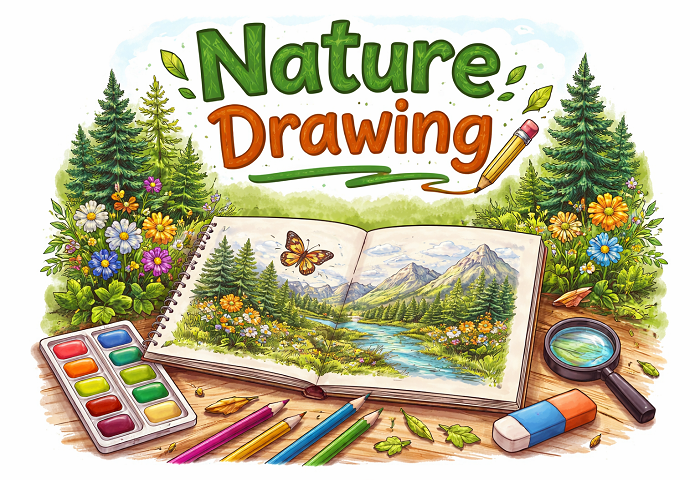
One of the most common misconceptions beginners carry is that quality nature drawing requires expensive equipment. It does not. The tools that matter most are simple, portable, and affordable. Here is what a well-stocked nature drawing kit looks like at every level.
Pencils (HB, 2B, 4B)
The backbone of any nature drawing kit. HB for light outlines, 2B for mid-tones, 4B for rich shadows and texture.
Sketchbook
Choose a hardcover sketchbook with at least 100gsm paper for pencil and light watercolor work outdoors.
Fineliner Pens
Waterproof fineliners (0.1mm–0.5mm) let you ink your nature sketches cleanly and add crisp botanical detail.
Watercolor Pan Set
A compact travel watercolor set adds color to your field sketches without the bulk of tubes or acrylics.
Hand Lens / Loupe
A 10x loupe magnifier reveals extraordinary detail in leaves, petals, and bark — transforming how you draw them.
Kneaded Eraser
Softer than standard erasers, kneaded erasers lift graphite gently without tearing paper or smearing fine lines.
As you progress in nature drawing, you may want to explore charcoal for dramatic landscapes, colored pencils for botanical illustration, or a tablet and stylus for sketching digitally. But for the vast majority of field sketching situations, pencils and a good sketchbook will carry you further than any premium supply ever could.
Best Nature Drawing Subjects for Every Skill Level
Choosing the right subject is half the battle in nature drawing, especially for beginners who can feel overwhelmed by the complexity of a forest or a detailed flower. The table below groups popular outdoor sketching subjects by difficulty and suggests an approach for each.
| Skill Level | Best Subjects | Approach |
|---|---|---|
| Beginner | Single leaves, pebbles, pine cones, simple flowers | Focus on outline and basic shading; avoid complex backgrounds |
| Intermediate | Tree bark, bird sketches, garden flowers, mushrooms | Add texture, value contrast, and simple compositional framing |
| Advanced | Full landscapes, wildlife in motion, detailed botanicals | Work with layered tones, perspective, and dynamic line quality |
| All Levels | Shells, feathers, seed pods, twigs | Rotate the object; draw from multiple angles in one session |
A pro tip many experienced nature drawing artists swear by: start small and close. Place a single oak leaf on your lap and draw it until you know every vein. That intimacy with a tiny subject trains your eye far more effectively than attempting a sweeping mountain landscape before you are ready.
Step-by-Step Guide: How to Start a Nature Drawing
Many beginners freeze when they sit down with a blank page outdoors. This step-by-step process will guide you through a complete nature drawing session from setup to finish.
-
1Choose your subject and positionFind a comfortable spot where you can sit still for 20–40 minutes. Place your subject — a flower, branch, or view — where it won’t shift with the breeze if possible. Good positioning is the foundation of a productivenature drawingsession.
-
2Observe before you drawSpend three full minutes just looking. Notice the overall shape, the biggest areas of shadow, the dominant lines. The most common mistake innature drawingis rushing to the pencil before the eye truly understands what it is seeing.
-
3Lightly sketch the basic shapesUsing an HB pencil with very light pressure, block in the large, simple shapes first. A tree is not individual leaves — it is a mass of oval or triangular form. Work loose and gestural; this is scaffolding, not the final drawing.
-
4Refine your linesWith a slightly heavier touch, begin defining the edges, contours, and key details. Innature drawing, varying your line weight — thicker at the base, thinner at the tips — creates a natural, organic feel that flat, uniform lines cannot achieve.
-
5Add tone and textureSwitch to a 2B or 4B pencil for shading. Study where the light hits your subject and where shadows fall. Innature drawing, texture is everything: cross-hatching for bark, smooth blending for petals, stippling for the rough surface of a stone.
-
6Add final details and notesMany field artists add written notes beside theirnature drawing— the species name, date, location, weather, and any interesting behavior observed. These annotations transform a simple sketch into a living field journal entry.
Core Techniques Every Nature Drawing Artist Should Master
Technique separates a competent sketch from a truly compelling one. These are the fundamental skills worth spending deliberate time developing.
Contour Drawing
Pure contour drawing — moving your pencil slowly along the edges and interior lines of your subject without lifting from the page — trains your eye to follow form with precision. For outdoor sketching, this means tracing every twist of a twig, every scallop of a leaf’s edge. Practice blind contour drawing (without looking at your paper) to build hand-eye coordination that no other exercise can replicate as efficiently.
Gesture Drawing for Wildlife
When drawing animals in outdoor sketching sessions, they will not sit still. Gesture drawing — capturing the essential movement and energy of a subject in 30 to 60 seconds — is the tool you need. Work in quick, confident lines that capture posture and motion rather than detail. A flock of sparrows calls for gesture; a single perched heron offers the luxury of longer study.
Hatching and Cross-Hatching
Hatching (parallel lines) and cross-hatching (overlapping grids of lines) are the workhorses of tonal rendering in nature drawing. The density of your hatching controls value: sparse lines read as light, dense lines read as shadow. Used with sensitivity, hatching gives botanical drawings and landscape sketches a beautiful graphic quality with depth and dimension.
Stippling for Texture
Stippling — building tone through hundreds of tiny dots — is slower than hatching but produces an exquisite, granular texture that works beautifully for rocks, mushrooms, seed heads, and aged bark in outdoor sketches. It is a meditative technique that rewards patience.
Understanding Value
Value — the range from lightest light to darkest dark — is what gives a nature drawing its sense of three-dimensionality and light. Squint at your subject: the mid-tones disappear and you are left with a simplified map of lights and darks. Drawing this map accurately is more important than rendering every detail.
- 70% of your drawing should be mid-tones — the main body of the subject.
- 20% should be shadow — creating depth and anchoring the form.
- 10% should be your lightest lights — the highlights that bring life and luminosity to the drawing.
- When in doubt, push your darkest darks darker. Most beginners innature drawingare too timid with shadow.
Nature Drawing Outdoors: The Field Sketching Practice
Field sketching is nature drawing in its purest form — working directly from life in a park, forest, garden, beach, or any outdoor setting. It requires adapting to changing light, wind, insects, and the unpredictability of living subjects. But those constraints are also what make it thrilling.
Build your outdoor nature drawing kit to be compact and weatherproof. A hardcover A5 sketchbook fits in most jacket pockets. A small pencil roll with four or five pencils, a fineliner, and a kneaded eraser is all you need. A folding stool or a wide brimmed hat that blocks sun from your page can be the difference between a comfortable session and a frustrating one.
Time management matters enormously in field nature drawing. Light changes dramatically every 20–30 minutes outdoors, especially near golden hour. Many field artists work in two phases: a quick gestural sketch in the first 10 minutes to capture composition and light direction, followed by a slower, detail-oriented second phase while referencing photos taken of the same scene.
Working directly from life in the field teaches you to make decisions fast and commit to them. That confidence — built session by session — is what separates field artists from studio artists in the quality of their observational instincts.
Nature Drawing for Kids: Making It Fun and Educational
Nature drawing is one of the best activities you can introduce to children. It pulls them outdoors, sharpens observation skills, builds concentration, and nurtures a genuine love of the natural world — all while developing fine motor coordination that supports handwriting and other academic tasks.
For young beginners, the key is to make nature drawing feel like an adventure rather than an art lesson. Go on a “treasure hunt” for interesting leaves, feathers, or flowers. Lay the collected objects on a flat surface and let children draw them at their own pace and in their own style. Encourage questions: “Why do you think this leaf has so many points?” or “What colour is the shadow under this mushroom?” That scientific curiosity deepens their engagement with the nature drawing process far more than any corrective instruction.
Provide a range of tools — not just pencils, but crayons, watercolors, and even twigs dipped in ink for mark-making. Children thrive on variety, and exploring different media keeps their sketching sessions fresh and unpredictable in the best possible way.
Digital Nature Drawing: Blending Tradition and Technology
Digital nature drawing has grown enormously as tools like the iPad Pro, Apple Pencil, and apps such as Procreate have matured. The advantages are compelling: infinite undo, no smearing, built-in color matching, and the ability to work in layers that let you separate your sketch from your shading from your color in ways that traditional media cannot replicate.
Many professional botanical illustrators and wildlife artists now use a hybrid workflow: pencil sketches made outdoors in the field are photographed and imported into a digital environment, where they are refined, inked, and colored digitally. This blends the authentic observational quality of traditional field sketching with the precision and flexibility of digital tools.
If you are transitioning from traditional to digital nature drawing, resist the temptation to rely on digital shortcuts immediately. Keep your brushes simple at first — a basic pencil brush, a flat ink brush, and a soft blending brush are enough to replicate most traditional sketching techniques digitally. Master the fundamentals in any medium before exploring the more advanced capabilities of your software.
Botanical Illustration: The Finest Tradition of Nature Drawing
Botanical illustration represents the apex of scientific nature drawing — a discipline demanding both artistic skill and biological accuracy. Botanical illustrators must render every structural detail of a plant with precision: the number of stamens, the exact venation pattern of each leaf, the way a stem cross-section looks under magnification. At its best, botanical illustration is indistinguishable from the plant itself in beauty and in instructive value.
To explore botanical illustration as part of your nature drawing practice, start with a single flower bud and draw it at multiple stages of opening. Work at slightly larger than life scale so you have room for detail. Use a sharp HB pencil for construction lines, a 0.3mm fineliner for final linework, and layer watercolor washes in thin, transparent glazes to build luminous petal color. The Royal Horticultural Society’s annual botanical art shows are an extraordinary reference for understanding where this tradition of observational art can lead at its highest level.
How to Develop a Consistent Nature Drawing Practice
Consistency beats intensity in nature drawing, as in most creative skills. Fifteen minutes of daily observation and sketching will build your abilities faster than a single five-hour session once a month. Here is a realistic framework for building a sustainable nature drawing habit.
📅 A Realistic Nature Drawing Weekly Plan
- Monday & Wednesday:15-minute sketches of a single small object — a leaf, a seed, a shell. Focus on line quality.
- Friday:30-minute session outdoors or near a window. Practice tonal shading with one subject.
- Weekend:One longer 60–90-minutenature drawingsession at a park, garden, or nature reserve. Bring your full kit.
- Ongoing:Keep a pocket sketchbook for 5-minute gesturalnature drawingwhenever you encounter something interesting in the world.
Review your sketchbook at the end of each month. Compare your earliest drawings to your most recent pages. Progress is often invisible day-to-day but strikingly obvious month-to-month. That comparison is enormously motivating and helps you identify the specific areas — perspective, value control, texture rendering — that deserve more focused attention in the weeks ahead.
Joining a local urban sketchers group or a nature drawing club brings the additional accountability and social warmth that makes a solo practice far more sustainable. Seeing how other artists interpret the same subject is one of the fastest ways to expand your own visual vocabulary.
Frequently Asked Questions About Nature Drawing
Start Your Nature Drawing Journey Today
Nature drawing is not a skill reserved for the gifted few. It is a practice — built patiently, one session at a time, one leaf or stone or cloud at a time — that is open to every person willing to sit still long enough to truly look at the world. The rewards are extraordinary: sharper observation, a deeper connection to living things, a growing catalogue of places and moments preserved in your sketchbooks, and the quiet, profound pleasure of having made something with your own hands from the world you inhabit.
Pick up a pencil. Find a leaf. Begin your first nature drawing today — and discover how much the world has been waiting to show you, if only you would slow down and look.