Roaring Fork Motor Nature Trail: Complete Guide
If you have ever dreamed of a drive that wraps you in old-growth forest, serenades you with rushing mountain streams, and delivers you back in time to Appalachian pioneer life all within minutes of a busy Tennessee tourist town — the Roaring Fork Motor Nature Trail is exactly what you have been looking for. Tucked just outside Gatlinburg, Tennessee, this extraordinary one-way loop is one of the most beloved and rewarding scenic experiences inside Great Smoky Mountains National Park. Whether you are a first-time visitor to the Smokies or a seasoned hiker returning for another season, the Roaring Fork Motor Nature Trail offers something that no other drive in the park quite replicates: a seamless blend of natural wonder, cultural heritage, accessible hiking, and genuine Appalachian spirit, all packed into a few magical miles.
This guide covers everything you need to know from how to get there and what to expect along the route to the best waterfalls, historic stops, hiking trails, wildlife tips, and practical advice for making the most of your visit.
What Is the Roaring Fork Motor Nature Trail?
The Roaring Fork Motor Nature Trail is a 5.5-mile one-way scenic loop road located inside Great Smoky Mountains National Park, just a short drive from downtown Gatlinburg. The trail takes its name from the Roaring Fork stream, a lively mountain creek that tumbles loudly over mossy boulders and rocky ledges alongside much of the road. When that stream runs high after rainfall, the roaring sound it makes is nothing short of dramatic — an natural soundtrack that sets the tone for the entire journey.
The road is narrow, winding, and limited to passenger vehicles only. No motorhomes, buses, or vehicles longer than 25 feet are permitted on this road. The one-way design keeps traffic flowing smoothly and eliminates the risk of head-on encounters on the tight curves, but it also means you cannot backtrack once you have entered the loop. The speed limit along most of the trail is just 10 miles per hour, which is not a restriction but an invitation slow down, roll your windows down, and truly absorb one of the most atmospheric drives in the entire eastern United States.
The Roaring Fork Motor Nature Trail is typically open from early April through November. It closes during the winter months, usually from early December through late March, due to weather conditions and road safety concerns. Always check the National Park Service website before planning your visit to confirm current road status.
How to Get to the Roaring Fork Motor Nature Trail
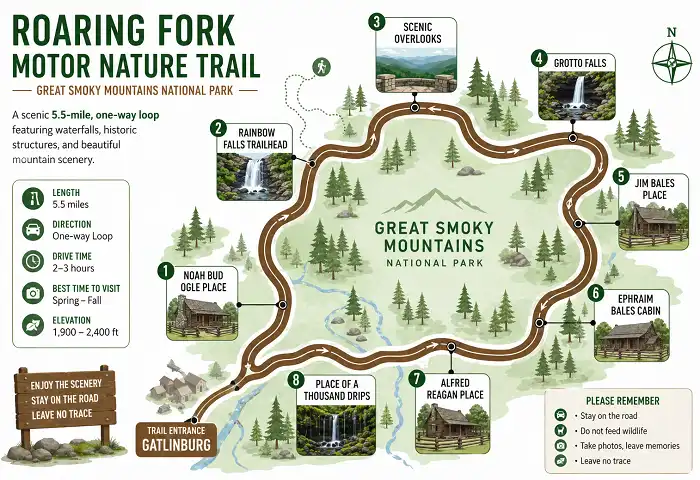
Getting to the Roaring Fork Motor Nature Trail is straightforward once you know the key landmark. From the main Parkway in downtown Gatlinburg, look for Traffic Light #8 and turn onto Historic Nature Trail Road. Follow this road which passes through a stretch of hotels and lodging properties — until you reach Cherokee Orchard Road, which begins at the only traffic light on that stretch. Cherokee Orchard Road takes you out of the town and into the boundary of Great Smoky Mountains National Park, winding for about 2.8 miles of two-way road before splitting into the one-way Roaring Fork Motor Nature Trail loop.
The entrance to the one-way portion of the Roaring Fork Motor Nature Trail is located just past the parking area for the Rainbow Falls Trail. Once you enter the one-way section, you are committed to completing the full loop, so make sure your gas tank is comfortable and that everyone in your vehicle has had a bathroom break before you start.
Parking is available at various pullouts and trailheads along the route. If you plan to stop for more than 15 minutes at any point, you will need a parking tag, which can be purchased through the park’s “Park It Forward” program online or at the visitor centers in Gatlinburg and at Sugarlands. The drive itself, however, is free. Great Smoky Mountains National Park charges no entrance fee, a tradition protected by federal legislation that goes back to 1951.
The Noah “Bud” Ogle Place: Where the Journey Begins
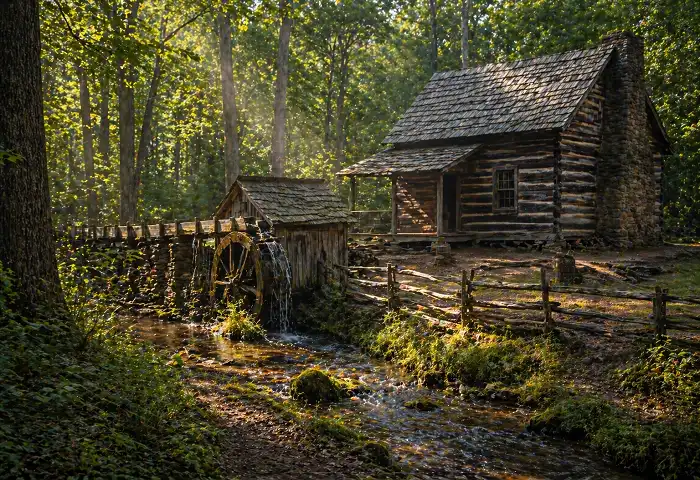
Before the one-way loop officially starts, your first meaningful stop along the Roaring Fork Motor Nature Trail corridor is the Noah “Bud” Ogle Place, located on the west side of Cherokee Orchard Road. This historic site is one of the finest examples of Appalachian farmstead preservation in the entire park system, and it sets the cultural tone for everything that follows.
Noah “Bud” Ogle was the great-grandson of one of the earliest settler families to arrive in this region, and the cabin he built here dates back to around the 1880s. A short self-guiding nature trail leads visitors through the farmstead, past a streamside tub mill, and alongside a remarkable hand-crafted wooden flume system that Ogle engineered to direct water from the creek to power his mill. The ingenuity on display here is a testament to the resourcefulness of Appalachian mountain communities, who built entire lives in these remote hollows using the land and water around them.
The Ogle Place also includes a large log house, a carriage house, and various outbuildings. Spend 20 to 30 minutes walking through the farmstead. It is peaceful, educational, and deeply moving — an authentic window into the lives of the people who called these mountains home long before the park existed.
Rainbow Falls Trailhead: The 80-Foot Giant
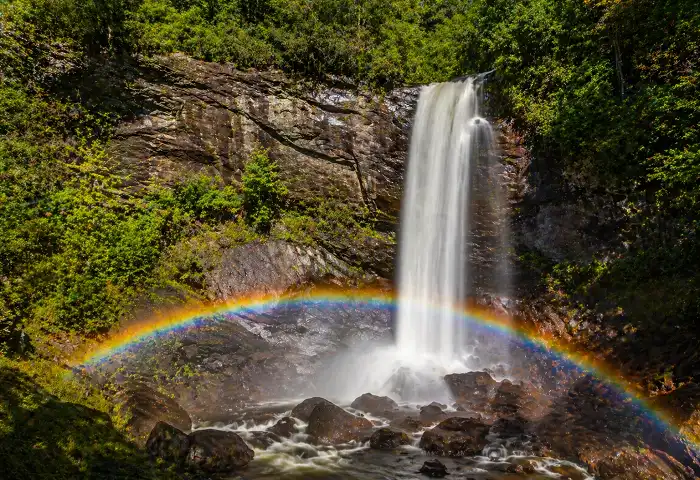
Just past the Ogle Place, before entering the official one-way loop of the Roaring Fork Motor Nature Trail, you will find the trailhead for Rainbow Falls. This is one of the most popular hikes in Great Smoky Mountains National Park, and for good reason. Rainbow Falls is the tallest single-drop waterfall in the park, plunging 80 feet over a rocky ledge into a mist-filled pool below.
The round-trip hike to Rainbow Falls is approximately 5.4 miles and involves about 1,500 feet of elevation gain, making it a moderately strenuous outing. The trail climbs steadily through a rich mixed forest and rewards hikers with a stunning cascade that, on sunny afternoons, creates a glowing rainbow in the mist — hence the name. Wear sturdy hiking shoes, bring plenty of water, and start early to avoid the afternoon crowds. The Bullhead Trail, which connects to Mount LeConte — the third-highest peak in the Smokies — also departs from this same trailhead, offering a much longer and more challenging option for experienced hikers.
Entering the One-Way Loop: Scenic Overlooks and Forest Immersion
Once you turn onto the official one-way section of the Roaring Fork Motor Nature Trail, the forest closes in around you almost immediately. The canopy overhead is dense, shading the narrow road and creating a cool, green tunnel effect that is particularly magical during the height of summer. The road climbs toward Piney Mountain, reaching an elevation of approximately 3,182 feet at its highest point before beginning a long, winding descent.
Among the first features you will encounter are two scenic overlooks positioned close together. The first faces northwest, back toward the town of Gatlinburg and the ridgelines beyond. The second appears shortly around a curve and offers a slightly different perspective of the mountain landscape. Both overlooks are ideal spots to pause, stretch your legs, and take in the layers of blue-green ridges that give the Great Smoky Mountains their famously hazy, dreamlike appearance. On clear mornings especially, these overlooks deliver views that feel almost impossibly beautiful.
Grotto Falls and the Trillium Gap Trail: A Walk Behind the Water
Midway through the Roaring Fork Motor Nature Trail, you will reach the parking area for the Trillium Gap Trail, which leads to one of the most beloved and visited spots in the entire park: Grotto Falls. This is the only major waterfall directly accessible from the Roaring Fork Motor Nature Trail, and it is the only waterfall in Great Smoky Mountains National Park where you can actually walk behind the cascading water.
Grotto Falls stands 25 feet tall and spills over a broad overhanging ledge into a cool, mossy grotto below. The trail to reach it follows the Trillium Gap Trail through an old-growth hemlock forest, covering approximately 1.3 miles one way. The round-trip distance is about 2.6 miles and is considered a moderate hike, manageable for most visitors including older children. The moist environment near the falls supports an extraordinary diversity of mosses, ferns, and salamanders the Great Smoky Mountains are famously called the “Salamander Capital of the World,” and the habitat around Grotto Falls is a prime example of why.
Walking behind the falls themselves is a genuinely thrilling experience. You step into a cool curtain of rushing water on a warm summer day and feel the spray on your face as the creek plunges just inches in front of you. It is a rare and magical moment that you will want to photograph from every angle. Pack a rain jacket or accept that you may get a little wet it is absolutely worth it.
Historic Cabins Along the Trail: Stories in Log and Stone
One of the most distinctive features of the Roaring Fork Motor Nature Trail is the series of beautifully preserved historic structures that appear at intervals along the route. These cabins, barns, corn cribs, and mills are not reconstructions or replicas they are authentic Appalachian buildings that date back to the 18th and 19th centuries, preserved in place so that visitors can connect with the human history of this landscape.
Among the most notable stops is the Jim Bales Place, a cluster of log structures situated in a wide, open meadow alongside the creek. Jim Bales and his older brother Ephraim both farmed the Roaring Fork area for most of their lives, and the homesteads they built reflect the rugged simplicity of mountain life. The cabin currently visible at the Jim Bales Place is actually the Alex Cole Cabin, which was relocated here from the Sugarlands area of the park when that area was being returned to nature. Jim’s own corn crib and barn, however, are original to the location.
Just down the road, the Ephraim Bales Cabin is easy to miss but well worth seeking out. Ephraim, Jim’s older brother, raised his wife and nine children in this modest homestead, which is actually two cabins placed side by side and connected by a shared roof. One side served as the living area while the other housed the kitchen a clever and practical arrangement for a large family living in a remote mountain hollow.
Further along the loop, the Alfred Reagan Place stands out as the only historic home along the Roaring Fork Motor Nature Trail that has been painted. Its cheerful blue-and-white exterior makes it look almost cheerful against the green forest backdrop. Adjacent to the Reagan home is the Alfred Reagan Tub Mill, a beautifully restored example of the water-powered corn mills that early settlers relied upon to grind their grain. The mill’s wooden flume and undershot wheel are impressive feats of low-technology engineering, and the structure itself is a photographer’s dream.
Place of a Thousand Drips: A Roadside Waterfall Wonder
Near the end of the Roaring Fork Motor Nature Trail loop, one more natural highlight awaits those who know where to look. The Place of a Thousand Drips is a seasonal roadside waterfall — one of only two waterfalls in the entire park that you can view directly from your vehicle without any hiking required.
After significant rainfall, water seeps and streams across a broad, sheer rock face on the left side of the road, creating dozens of overlapping rivulets that combine into a shimmering, ever-shifting curtain of water. The effect is hypnotic and hauntingly beautiful, and it fully earns its poetic name. During dry spells, the drips may be minimal or absent entirely, which means the Place of a Thousand Drips is best experienced in spring or after a period of heavy rain. Keep your eyes open as you approach the sharp curve where it is located — it is easy to drive right past if you are not paying close attention.
Wildlife Watching Along the Roaring Fork Motor Nature Trail
The Roaring Fork Motor Nature Trail is not only a feast for the eyes in terms of scenery and history — it is also an excellent location for wildlife observation. Great Smoky Mountains National Park supports over 65 species of mammals, more than 200 types of birds, and over 80 species of reptiles and amphibians, and many of them make their home in the dense forest corridors that border the trail.
White-tailed deer are commonly spotted grazing in the open meadows near the historic homesteads, particularly in the early morning and late afternoon. Black bears, for which the Smokies are famously known, do occasionally appear along this stretch of road, though sightings are less predictable than in Cades Cove. Wild turkeys, ruffed grouse, and various songbirds can be heard and seen throughout the dense forest canopy. The streamside habitat along the Roaring Fork creek is particularly rich in salamanders, crayfish, and native brook trout.
If wildlife watching is a priority during your visit, bring binoculars and plan your drive for either early morning or the hour before sunset, when animal activity is highest. Move slowly, keep noise to a minimum, and never approach or feed any wildlife for their safety and yours.
Best Time to Visit the Roaring Fork Motor Nature Trail
The Roaring Fork Motor Nature Trail is a four-season destination in the sense that it offers something remarkable at virtually every time of year when it is open but the experience does vary significantly by season.
Spring, from April through early June, is arguably the most spectacular time to visit. Wildflowers carpet the forest floor, including trilliums, violets, and the beloved flame azaleas that explode into orange and red along the higher elevations. Migrating songbirds fill the trees, and the waterfalls run at their fullest after winter snowmelt and spring rains. The Place of a Thousand Drips is at its most dramatic during this period.
Summer brings lush green canopy, comfortable shade, and ideal conditions for hiking to Grotto Falls and Rainbow Falls. The forest is at its deepest, most vibrant green, and the streams are cool and refreshing. Weekdays are less crowded than weekends, and early mornings offer the best chance of a peaceful experience before tour groups and day-trippers arrive.
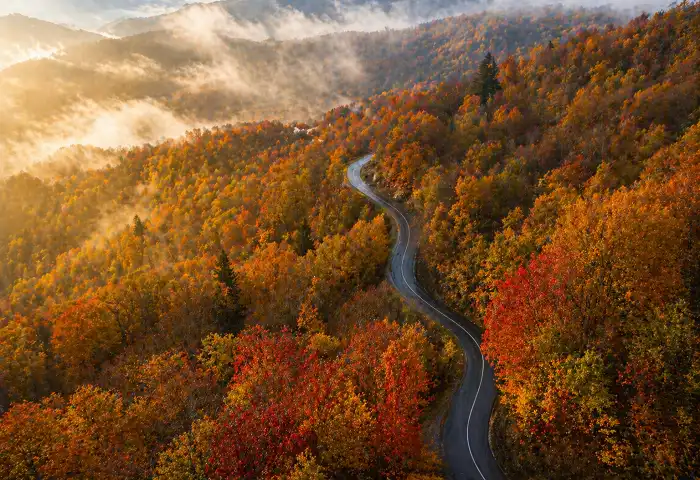
Autumn is perhaps the most visually stunning season on the Roaring Fork Motor Nature Trail. The hardwood forest erupts in spectacular color from late September through early November, with yellows, oranges, and deep reds set against the dark evergreens. Autumn is also the busiest season in the Smokies overall, so expect fuller parking areas and slower traffic on the loop itself.
Practical Tips for a Perfect Visit
A few smart pieces of planning will make your day on the Roaring Fork Motor Nature Trail significantly more enjoyable. First, arrive early. The trail opens at dawn, and the first hour or two of the morning offers the least traffic, the best wildlife activity, and the most serene atmosphere.
Second, check road conditions before you go. The Roaring Fork Motor Nature Trail is subject to temporary closures after heavy rain, fallen trees, or other natural events. The National Park Service updates road conditions on their website and at the visitor centers.
Third, bring the right supplies. Even if you do not plan to hike, pack water, snacks, a light jacket, and comfortable walking shoes so you can get out and explore the historic sites and creek pullouts along the way. Sunscreen and insect repellent are wise additions from late spring through early fall.
Fourth, download or pick up a paper copy of the self-guided motor trail brochure. The NPS produces an excellent numbered guide that corresponds to stops along the road, helping you identify each landmark and understand its historical context. You can download it from the NPS website or pick one up at the Sugarlands Visitor Center near the park entrance.
Finally, respect the road’s limitations. No vehicles over 25 feet, no backing up once you have entered the one-way section, and always yield to uphill traffic at the narrow passages. Drive at 10 miles per hour or below, and resist the urge to stop in the middle of the road when you spot something interesting use the designated pullouts to park safely.
Why the Roaring Fork Motor Nature Trail Belongs on Every Smokies Itinerary
There are hundreds of things to do in Great Smoky Mountains National Park, from popular hikes along Alum Cave Trail to sunset views from Clingmans Dome and lazy afternoons at Abrams Falls. But the Roaring Fork Motor Nature Trail holds a special place among all of them because it does not ask you to choose between nature and history, between driving and hiking, between solitude and discovery.
Within a single loop of just a few miles, you can sit in your car and absorb the sound of a roaring mountain creek. You can step out and walk behind a waterfall. You can stand in a pioneer cabin and imagine what winter nights felt like for a family of eleven. You can photograph a painted farmhouse, a wooden grist mill, and a wild turkey all in the same afternoon. You can smell the cold, clean air of an old-growth hemlock forest and watch the light filter through the canopy in long, golden shafts.
The Roaring Fork Motor Nature Trail is, in other words, the Smoky Mountains in miniature a concentrated, accessible, and deeply moving expression of everything that makes this national park one of the most visited and most beloved in the entire country. Whether you have two hours or an entire day, put it on your list. Drive it slowly. Stop often. And let the Roaring Fork do what it has always done best: roar.
FAQs
Is the Roaring Fork Motor Nature Trail free?
Yes. The drive itself is free and no entrance fee is required for Great Smoky Mountains National Park. A parking tag is required if you stop your vehicle for more than 15 minutes, and this can be purchased online or at visitor centers.
Can I take an RV on the Roaring Fork Motor Nature Trail?
No. The road is limited to passenger vehicles and trucks under 25 feet in length. RVs, motorhomes, buses, and towed trailers are not permitted on this narrow loop road.
When does the Roaring Fork Motor Nature Trail close?
The road typically closes from early December through late March due to winter weather. It reopens in early April, though the exact dates vary each year.
How long does it take to drive the Roaring Fork Motor Nature Trail?
Without stops, the loop takes approximately 30 to 45 minutes. With stops at historic sites, overlooks, and trailheads, plan for 2 to 4 hours. Adding a hike to Grotto Falls or Rainbow Falls can extend your visit to a full day.
Is the Roaring Fork Motor Nature Trail good for families with young children?
Absolutely. The drive is gentle and accessible, and many of the stops including the historic cabins, scenic overlooks, and the short walk to the creek are suitable for all ages. The hike to Grotto Falls is moderate and manageable for older children.