Patterns in Nature: What Causes Them and Where to Find
Patterns in nature are recurring shapes and structures that appear across plants, animals, landscapes, and entire ecosystems. This guide covers the main types of patterns in nature, explains what causes each one, and shows you where to spot them in everyday life. Whether you teach, study science, or just love the outdoors, you’ll find clear and useful answers here.
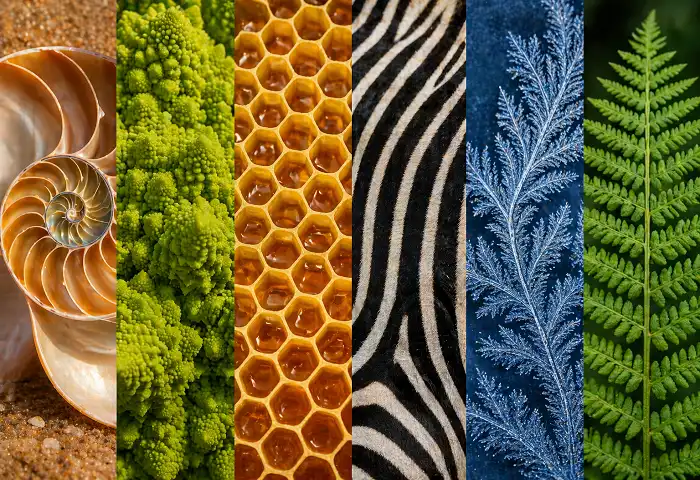
Patterns in nature are repeating visual or structural arrangements that form because physical forces, chemical gradients, and growth rules follow consistent mathematical laws. The six most common patterns in nature include spirals, fractals, symmetry, branching, tessellations, and reaction-diffusion stripes. Each one appears independently across unrelated species and environments because the same underlying rules produce the same geometric outcomes.
What Are Patterns in Nature?
Patterns in nature are any repeated arrangements, shapes, or sequences that show up in living or non-living systems. They are not random. They follow natural laws, from fluid dynamics and cell division to genetic coding and surface tension.
Scientists who study how biological shapes develop work in a field called morphogenesis. Mathematicians study the same forms through geometry and topology. Both fields confirm the same conclusion: patterns in nature repeat with measurable precision across wildly different organisms and scales.
A nautilus shell spiral mirrors a galaxy’s spiral arm. A river delta branches like a tree’s root system. The scale changes, but the rule stays the same.
The 6 Major Types of Patterns in Nature
1. Spirals
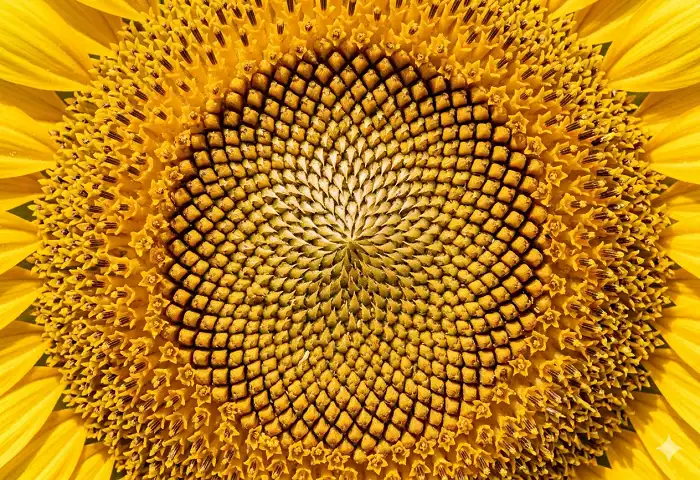
Spirals rank among the most recognized patterns in nature. They appear in shells, hurricanes, sunflower seed heads, pinecones, and galaxies. The most studied version is the Fibonacci spiral, which grows outward at the golden ratio (approximately 1.618).
In sunflowers, seeds arrange in two sets of intersecting spirals. Consecutive Fibonacci numbers, typically 34 spirals going one direction and 55 going the other, describe this arrangement. It packs the most seeds into the least space.
The nautilus shell grows as a logarithmic spiral, adding new chamber volume at a constant rate so the organism grows without changing body proportions.
2. Fractals: Patterns in Nature That Repeat at Every Scale
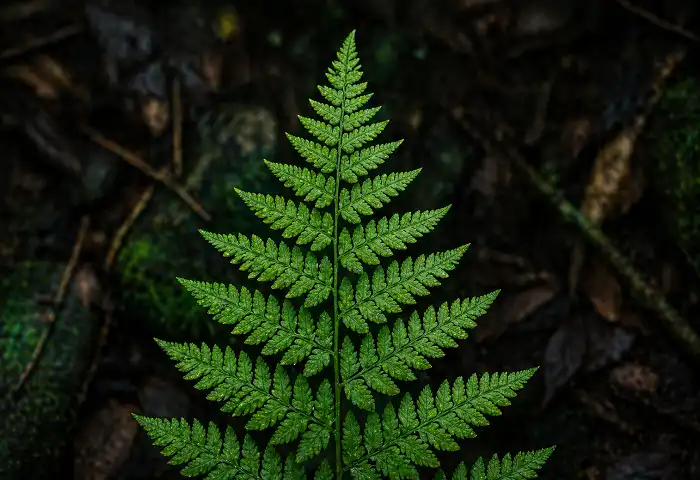
Fractals are self-similar structures. Zoom into any section of a fractal and it looks like the whole. This self-similarity is one of the most striking patterns in nature.
Clear examples include:
- Fern leaves – each frond mirrors the full leaf
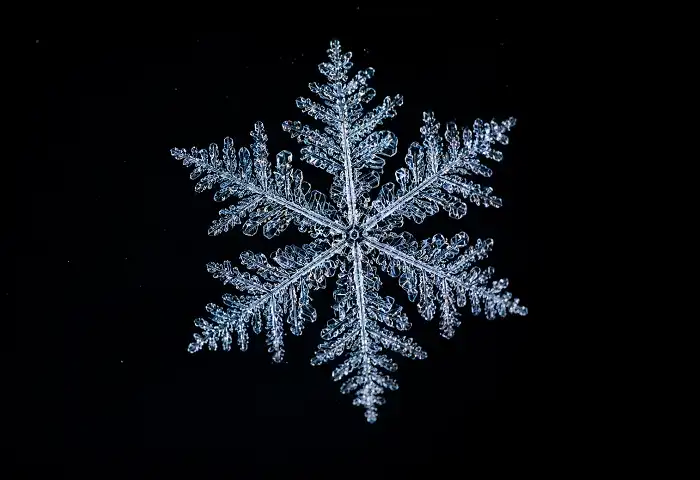
- Snowflakes – six-fold symmetry repeating at every scale
- Broccoli romanesco – every floret is a miniature of the whole head
- Coastlines – smaller sections resemble the entire shoreline
- Clouds – similar shapes appear at every zoom level
Fractals form because a single growth rule repeats over and over. One branching instruction, repeated thousands of times, builds a full tree. Benoit Mandelbrot formalized fractal geometry in the 1970s, but patterns in nature had been using self-similarity far longer.
3. Symmetry
Symmetry produces some of the most immediately visible patterns in nature. Bilateral symmetry, where left and right mirror each other, dominates the animal kingdom. Most vertebrates, insects, and flowering plants use it.
Radial symmetry, where identical sections radiate from a central point, appears in sea stars, jellyfish, daisies, and sea urchins. These organisms typically live in environments where all sides face equal conditions.
Symmetry reflects evolutionary fitness. Predators assess symmetry when selecting mates. High symmetry often signals genetic health and developmental stability across species.
4. Branching Patterns
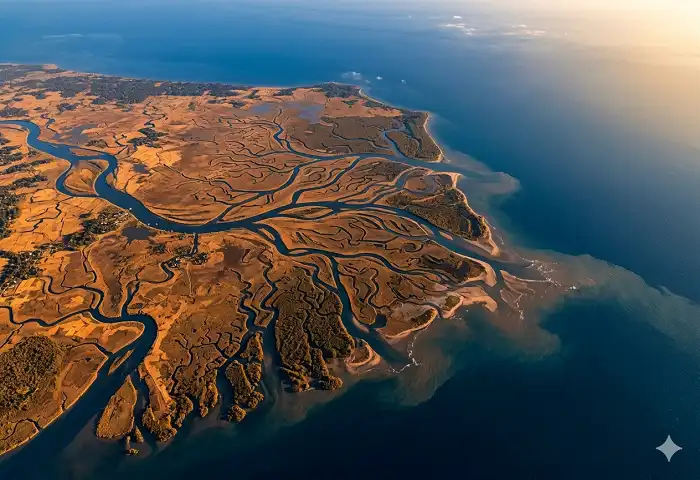
Branching structures appear wherever a system needs to distribute something efficiently. Trees, rivers, lungs, blood vessels, and lightning all use the same branching logic.
The reason is mathematical. A branching network reaches the maximum area using the minimum material. Your circulatory system carries blood to trillions of cells through a hierarchy that starts at the aorta and ends at capillaries one cell wide.
Murray’s Law describes how branch width scales with flow requirements in biological systems. Trees follow similar rules for water transport. Rivers branch because water takes the path of least resistance, and over time smaller streams merge into the same tree-like shape visible in vascular tissue.
5. Tessellations
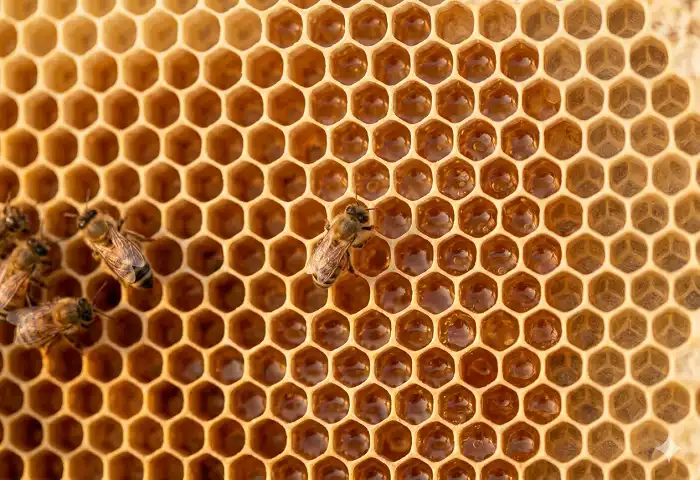
A tessellation is a pattern of shapes that tiles a surface with no gaps and no overlaps. Honeycombs, turtle shells, giraffe patches, pineapple skin, and the Giant’s Causeway basalt columns all show tessellating patterns in nature.
Honeybees build hexagonal cells because the hexagon packs equal areas using less material than any other shape. Mathematicians formally confirmed this, known as the honeycomb conjecture, in 1999.
Basalt columns form hexagonal cross-sections as lava cools and contracts. Tension pulls inward from multiple points, and the crack network settles into hexagonal geometry naturally.
6. Stripes and Spots
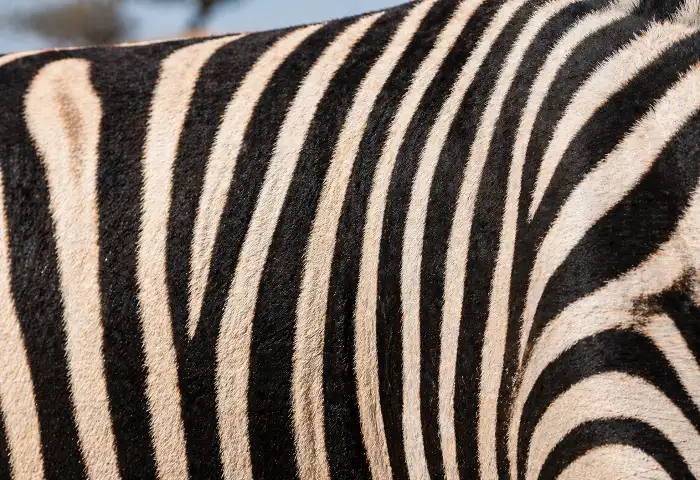
Zebra stripes, snake rings, leopard spots, and cheetah markings all arise from the same biological process. In 1952, mathematician Alan Turing proposed that two interacting chemicals, an activator and an inhibitor, spread through tissue at different rates and create alternating zones of high and low pigment.
This reaction-diffusion model now has strong experimental support and explains several recurring patterns in nature. Fast inhibitors relative to activators produce spots. Slow inhibitors produce stripes. Butterfly wings, tropical fish, and snake scales all follow the same mechanism.
Where to Find Patterns in Nature
You don’t need a forest or lab to observe patterns in nature:
- Kitchen: Cut a cabbage to see logarithmic spiral layers. Slice a bell pepper to reveal radial symmetry.
- Garden: Count spirals in a sunflower head or pinecone. Look for bilateral symmetry in leaves.
- Outdoors: Watch frost form on glass for fractal dendrite growth. Observe sand after wind for ripple periodicity.
- Aerial views: Satellite images of river deltas and dry lake beds reveal branching and tessellation patterns clearly.
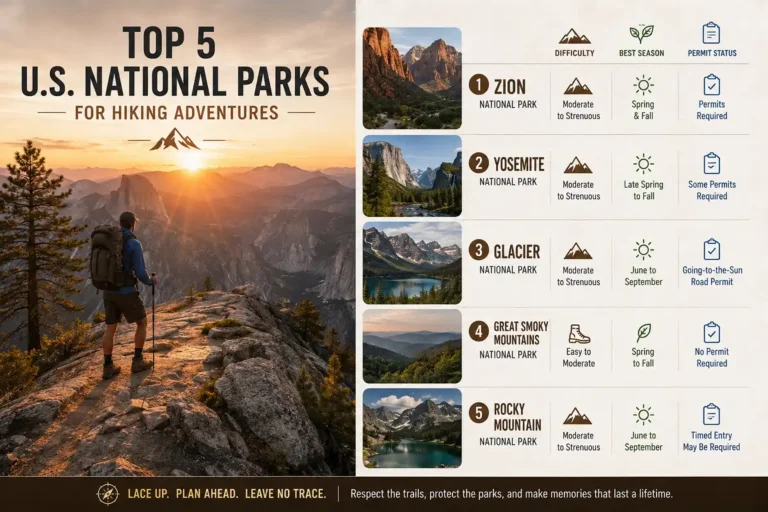
If you enjoy exploring scenery directly, nature trails near you give you an easy way to observe these forms up close.
Why Do Patterns in Nature Form?
Most patterns in nature form because a simple rule, applied repeatedly under physical constraints, produces the same outcome every time.
Growth constraints explain spirals. Cells divide at rates tied to resource availability and space. Radial constraints push growth into a spiral path that maximizes surface area.
Minimization principles explain branching and tessellations. Nature consistently finds the shape that uses the least energy or material for a given function. This is why hexagons, logarithmic spirals, and branching networks appear independently in completely unrelated organisms.
Chemical gradients explain stripes and spots. Turing’s reaction-diffusion model describes how chemical waves form and stabilize during embryonic development, producing the pigment patterns in nature we see on animal skin.
Physical forces explain basalt columns, ice crystal growth, and sand ripples. Cooling, tension, and wind impose directional constraints, and material responds in predictable geometric ways every time.
Patterns in Nature and Mathematics
Mathematics describes patterns in nature with unusual accuracy. The Fibonacci sequence (0, 1, 1, 2, 3, 5, 8, 13, 21…) appears in flower petal counts, pinecone spiral numbers, and phyllotaxis, the arrangement of leaves around a stem.
The reason connects to growth efficiency. Leaves arranged at the golden angle (approximately 137.5 degrees apart) never block each other’s sunlight. No other angle distributes them as evenly. The plant doesn’t calculate this. It simply grows each new leaf at the mechanically lowest-energy position, which happens to be the golden angle every time.
Fractal dimension, drawn from chaos theory, measures how completely a fractal fills space. Coastlines, trees, and lung airways all carry non-integer fractal dimensions, meaning they occupy geometric complexity somewhere between flat and solid.
For those interested in how the natural world gets described, exploring words for the natural world builds vocabulary for discussing patterns in nature with precision.
Patterns in Nature Across Different Environments
Ocean
Waves are periodic patterns produced by wind transferring energy to water. Sand on the seafloor forms ripple marks through the same fluid dynamics that builds desert dunes. Seashells are among the clearest examples of logarithmic spiral patterns in nature.
Arctic and Alpine
Permafrost creates polygon patterns in soil called patterned ground. Freeze-thaw cycles sort stones by size into rings and grids, producing large-scale tessellating patterns in nature visible from the air.
Ice crystals grow six-fold dendrite fractals because water molecules bond at 60-degree angles during crystallization. Every snowflake is unique, but all reflect the same hexagonal symmetry.
Forests and Plants
Phyllotaxis follows Fibonacci angles in most plant species. Tree crowns and root networks mirror the branching of rivers and blood vessels. Spiral grain appears in tree trunks when growth follows a helical path upward through the wood.
If you’re interested in applying these forms creatively, nature-inspired art ideas offer practical ways to use patterns in nature in your own work.
What Patterns in Nature Have Taught Engineering and Medicine
Patterns in nature have influenced design and technology in direct, measurable ways.
Branching vascular networks inform cooling system design and microfluidic chips. Fractal antenna designs, based on natural branching geometry, receive signals across wider frequency ranges than traditional straight antennas. Shark skin’s tessellated micro-scale pattern reduces drag and inspired competitive swimwear surface textures.
In medicine, disrupted patterns in nature can signal disease. Abnormal branching in lung scans, irregular pigment distribution on skin, or unusual symmetry in cell growth all serve as diagnostic markers.
Understanding patterns in nature also builds environmental awareness. Irregular tree branching, disturbed river meander patterns, and abnormal frost polygon formation can all indicate environmental stress before larger damage becomes visible.
Final Thoughts
Patterns in nature form because physical laws, chemical gradients, and growth constraints produce the same geometric outcomes across different organisms and environments. Spirals, fractals, symmetry, branching, tessellations, and reaction-diffusion markings all trace back to a small set of mathematical principles.
Once you learn to recognize patterns in nature, you see them constantly. A pinecone becomes a Fibonacci counter. A tree becomes a fractal structure. A basalt cliff becomes a natural tessellation. The natural world operates on repeating rules, and knowing them makes every outdoor walk a bit more interesting.