
Jolly Nature Pokémon: Top Picks & Pro Battle Tips
Speed wins battles and in Pokémon, nothing delivers raw speed better than a jolly nature Pokémon. If you’ve ever lost a match because your opponent moved first by a single point, you already know why nature choices matter enormously.
This guide covers everything about jolly nature Pokémon: what it does to your stats, which Pokémon benefit the most, how it stacks up against Adamant nature, and actionable tips to build a team that consistently outpaces the competition. Whether you’re new to competitive play or refining your meta squad, this is your complete reference.
What Is Jolly Nature Pokémon?
In Pokémon, every nature modifies two stats one gets a +10% boost and another takes a −10% penalty. Jolly nature follows this rule precisely:
- +10% Speed (boosted)
- −10% Special Attack (reduced)
This makes jolly nature Pokémon one of the most sought-after natures for physical attackers that need to move first. Since Special Attack is irrelevant to physical moves, the trade-off is almost always worth it.
You can explore a full breakdown of every available nature and its effects in this complete Pokémon nature chart guide — essential reading before you start building your team.
How Nature Affects Competitive Battles
In competitive Pokémon (VGC, Smogon OU, etc.), the Speed tier is everything. Moving first allows you to:
- KO threats before they act
- Set up entry hazards or screens safely
- Revenge kill at critical moments
- Break Focus Sash users with residual damage
A single point of Speed advantage can swing an entire match. That’s why serious players almost always run jolly nature Pokémon on their speed-dependent physical attackers.
Jolly Nature vs. Adamant Nature: Which Is Better?
This is the most debated choice in competitive Pokémon. Here’s the honest breakdown:
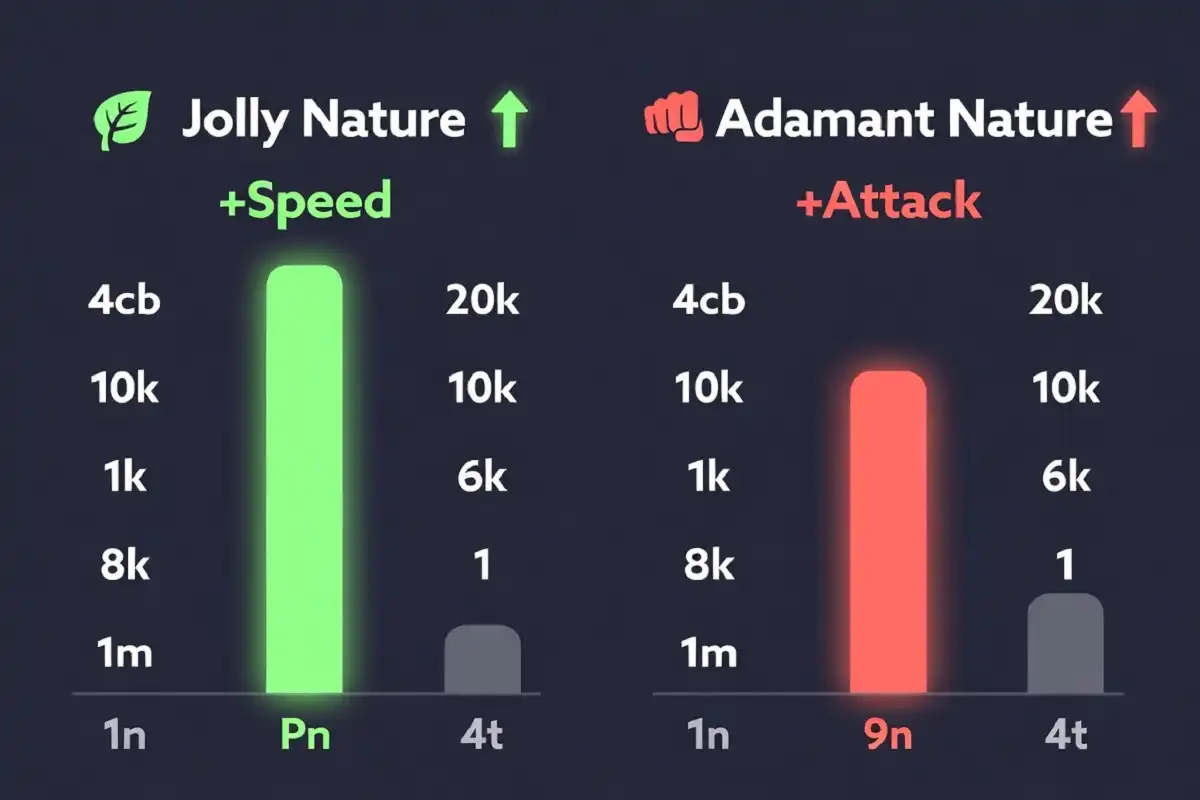
| Feature | Jolly Nature | Adamant Nature |
|---|---|---|
| Speed | +10% | No change |
| Attack | No change | +10% |
| Special Attack | −10% | −10% |
| Best For | Outpacing threats | Maximizing raw power |
| Tier Use | Most common in fast metas | Common in slow/bulky teams |
When to choose Jolly:
- Your Pokémon sits in a crowded Speed tier (e.g., base 100–115)
- You need to outspeed specific threats in the current meta
- The Pokémon already has high base Attack and doesn’t need Adamant’s boost
When to choose Adamant:
- Your Pokémon is already faster than most threats naturally
- You need damage thresholds that Jolly can’t hit
- You’re running Trick Room teams where Speed works against you
For Pokémon like Garchomp, Dragonite, and Lucario, the jolly vs. adamant debate comes down to whether you’re targeting specific speed benchmarks — which we’ll cover in the picks section below.
Best Jolly Nature Pokémon: Top Picks for Every Role
1. Garchomp — The Speed Dragon
Base Speed: 102 Why Jolly? Garchomp sits in one of the most competitive Speed tiers. Running jolly nature Pokémon lets it outspeed base 100 threats like Charizard and Salamence, as well as positive-natured base 95 Pokémon.
- Role: Physical sweeper / wallbreaker
- Signature moves: Earthquake, Dragon Claw, Scale Shot
- EV spread: 252 Atk / 252 Spe / 4 HP
- Key benchmark: Outspeeds neutral-natured Dragapult with Scarf sets neutralized

2. Lucario — The Speed Fighter
Base Speed: 90 Why Jolly? With jolly nature, Lucario hits 279 Speed (max EVs), letting it outspeed neutral-natured Pokémon in the base 85–89 range. It also bypasses the need for a Choice Scarf against mid-tier threats.
- Role: Sweeper with Swords Dance
- Signature moves: Close Combat, Extreme Speed, Iron Tail
- EV spread: 252 Atk / 252 Spe / 4 HP
3. Tyranitar — Scarfed Revenge Killer
Base Speed: 61 Why Jolly? On its own, Tyranitar is slow but with a Choice Scarf and jolly nature, it hits 369 Speed, outrunning a massive portion of the unboosted meta.
- Role: Revenge killer / sand setter
- Key move: Stone Edge, Crunch, Pursuit (older gens)
- Note: Adamant Scarf Tyranitar hits harder but misses key Speed benchmarks
4. Excadrill — Sandstorm Speed Machine
Base Speed: 88 (135 in sand) Why Jolly? In sandstorm, Excadrill’s Speed doubles. Jolly nature Pokémon pushes this even further, making it nearly uncatchable under sand conditions.
- Role: Sand sweeper
- EV spread: 252 Atk / 252 Spe / 4 HP
- Ability: Sand Rush (essential)
5. Breloom — The Spore Setter
Base Speed: 70 Why Jolly? Breloom uses Spore to shut down opponents before they can act. Jolly nature Pokémon helps it move before slower threats and slower support Pokémon to land the crucial sleep move.
- Role: Spore + Swords Dance sweeper
- Key moves: Spore, Mach Punch, Seed Bomb
- Note: Technician + Mach Punch is devastating after a SD
6. Dragonite — Classic Physical Attacker
Base Speed: 80 Why Jolly? After a Dragon Dance, Dragonite hits massive Speed tiers with jolly nature — outpacing Choice Scarf users at +1 and sweeping entire teams.
- Role: Dragon Dance sweeper
- EV spread: 252 Atk / 252 Spe / 4 HP
- Ability: Multiscale (gives it free setup turn)
7. Weavile — Dark Ice Assassin
Base Speed: 125 Why Jolly? Even at base 125, jolly nature ensures Weavile outspeeds every base 120 Pokémon and creeps ahead of other fast threats.
- Role: Revenge killer / lead
- Key moves: Ice Shard, Knock Off, Triple Axel
How to Get Jolly Nature Pokémon
Method 1: Breeding with Everstone
Hold an Everstone on the parent Pokémon with jolly nature, and there’s a 50% chance the offspring will inherit that nature. This is the most reliable breeding method.

Method 2: Mints (Generation VIII+)
From Sword and Shield onwards, Jolly Mints change how a Pokémon’s stats behave as if it had jolly nature Pokémon – without actually changing the nature itself. Perfect for fixing nature on caught legendaries.
Method 3: Catching with Synchronize
Lead with a Synchronize Pokémon that has jolly nature. Wild Pokémon have a 50% chance of having the same nature as your Synchronize user. Ideal for catching jolly nature Pokémon in the wild.
You can also compare jolly nature strategies alongside similar physical attackers by reading about the timid nature Pokémon guide — timid does the same speed boost, but for special attackers instead.
Jolly Nature and EVs: Building the Perfect Spread
Jolly nature alone won’t win battles you need the right EV (Effort Value) spread to maximize its benefits.
Standard physical sweeper spread:
- 252 Speed EVs — Hit the highest possible Speed stat
- 252 Attack EVs — Maximize offensive output
- 4 HP EVs — Minor bulk improvement
Bulky attacker spread (for walls that still need Speed):
- 252 Attack EVs
- 128 Speed EVs (enough to hit specific benchmarks)
- 128 HP EVs (added survivability)
Always calculate Speed benchmarks before finalizing your spread. Tools like the Bulbapedia nature guide and Smogon’s damage calculator make this easy.
Jolly Nature in Doubles & VGC
In VGC (Video Game Championships), jolly nature becomes even more critical. Turn order in doubles is heavily influenced by Speed, and many top-tier strategies depend on moving first:

- Tailwind support — Your fast jolly attackers double Speed for 4 turns
- Fake Out leads — Need to outspeed opponents to flinch first
- Redirection + Sweeper combos — Your sweeper needs to strike before redirection fails
For broader Pokémon nature strategy, check out the complete Pokémon nature guide to understand how all 25 natures interact with team building.
Common Mistakes When Using Jolly Nature
- Using Jolly on Special Attackers — Never. The -10% Sp. Atk penalty kills your damage output.
- Ignoring Speed Tiers — Running Jolly without checking if it actually outspeeds your target threats wastes the nature.
- Jolly on Trick Room Teams — Trick Room reverses Speed order. Jolly becomes a liability here; use Brave or Quiet natures instead.
- Forgetting IVs — Jolly nature with 31 Speed IVs is standard. A Pokémon with less-than-perfect Speed IVs won’t hit its benchmark even with jolly.
For comparison, you can explore how similar physical natures like impish nature in Pokémon work for defensive builds that still care about the physical side of combat.
FAQs
What does jolly nature do in Pokémon?
Jolly nature increases a Pokémon’s Speed stat by 10% and decreases its Special Attack by 10%. It’s ideal for physical attackers that need to move first in battle.
Is jolly or adamant better for most physical attackers?
It depends on the Speed tier. Jolly is better when your Pokémon needs to outspeed specific threats. Adamant is better when raw power matters more than moving first. Many competitive players test both against their target meta.
Which Pokémon benefit most from jolly nature?
Pokémon like Garchomp, Lucario, Excadrill, Weavile, and Dragonite (after Dragon Dance) all benefit strongly from jolly nature Pokémon due to their physical move sets and contested Speed tiers.
Can I change a Pokémon’s nature after catching it?
In Generation VIII and later, you can use a Jolly Mint to make a Pokémon behave as if it has jolly nature. In earlier games, you’d need to breed or recatch with Synchronize.
Does jolly nature affect a Pokémon’s appearance or personality?
No nature only affects stats in battle. It doesn’t change the Pokémon’s appearance, nickname, or in-game personality text (though natures do have flavor descriptions).
What’s the difference between jolly and timid nature?
Both boost Speed by 10%. Jolly reduces Special Attack (great for physical attackers), while timid reduces Attack (great for special attackers). Choose based on whether your Pokémon primarily uses physical or special moves.
Conclusion
Jolly nature Pokémon give you the competitive edge that separates good teams from great ones. The Speed boost is simple but decisive moving first means controlling the battle, and controlling the battle means more wins.
To recap the key points:
- Jolly nature = +10% Speed, −10% Special Attack
- Best for physical attackers in contested Speed tiers
- Top picks: Garchomp, Lucario, Excadrill, Weavile, Dragonite, Breloom, Tyranitar
- Get jolly nature via breeding + Everstone, Jolly Mints, or Synchronize
- Always check Speed benchmarks before finalizing your EV spread
Ready to build your fastest team yet? Start with one jolly nature Pokémon from this list, run it in a few ranked battles, and feel the difference that a single nature choice makes. For more competitive strategy, explore our full jolly nature guide and take your game to the next level.