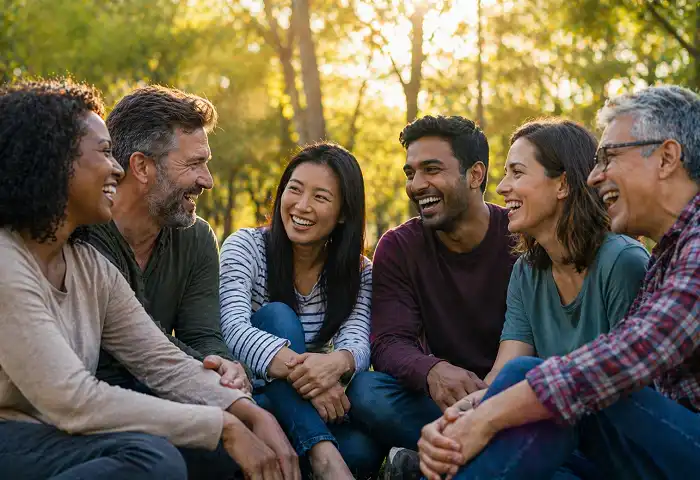
The Social Nature of Humans: Why We Are Built to Connect

There is a reason solitary confinement is considered one of the harshest punishments in the modern prison system. There is a reason the phrase “I feel lonely” can ache just as painfully as a physical wound. And there is a reason why, during the height of global lockdowns, millions of people around the world reported surging anxiety, depression, and a profound sense of loss even when they were physically safe, well-fed, and sheltered.
That reason is simple: the social nature of human beings is not a personality trait. It is not a preference. It is a biological, psychological, and evolutionary reality woven into the very fabric of who we are.
From the moment we are born crying into the arms of another person, to the last breath we take surrounded by those we love, our entire lives are shaped by connection. We seek it. We fight for it. We grieve when we lose it. Understanding our social nature is not merely an academic exercise it is one of the most practical things we can do to improve our health, our happiness, and the quality of the societies we build together.
This blog post dives deep into the science, history, and everyday experience of our social nature. You will discover why humans evolved as social creatures, what happens to us when connection is severed, how our social instincts shape everything from our language to our immune systems, and what we can all do to nurture the bonds that keep us truly human.
Part 1: What Does “Social Nature” Actually Mean?
When scientists, philosophers, and psychologists use the term social nature, they are referring to the innate human drive to live, work, and thrive within groups. This is not simply about enjoying parties or being an extrovert. The social nature of our species describes a fundamental orientation toward others — a biological wiring that makes cooperation, communication, and community not just pleasant but necessary.
Aristotle captured this idea beautifully more than two thousand years ago when he declared that humans are “social animals.” He meant that human beings, unlike solitary predators, cannot fully develop or flourish outside of relationships with others. A person raised in complete isolation would not merely be unhappy they would fail to develop language, empathy, complex reasoning, or moral understanding. These capacities emerge only through interaction with other minds.
Modern neuroscience confirms what ancient philosophy suspected. Brain imaging studies show that the human brain lights up differently when we process social information compared to non-social information. Our brains have dedicated regions — including the medial prefrontal cortex, the temporoparietal junction, and the mirror neuron system — that are specifically tuned to reading faces, interpreting emotions, tracking social relationships, and predicting the behavior of others.
In other words, your brain is, in large part, a social organ. Its most sophisticated features evolved not to solve math problems or compose symphonies, but to navigate the breathtaking complexity of human relationships.
The social nature of humans also distinguishes us from most other species in a critical way: the scale and sophistication of our cooperation. While many animals live in groups, human beings cooperate with strangers, build institutions, write laws, trade goods across continents, and coordinate efforts involving millions of people who have never met. No other species does anything remotely close to this. That capacity rooted entirely in our social nature is the engine behind civilization itself.
Part 2: The Evolutionary Roots of Human Social Behavior
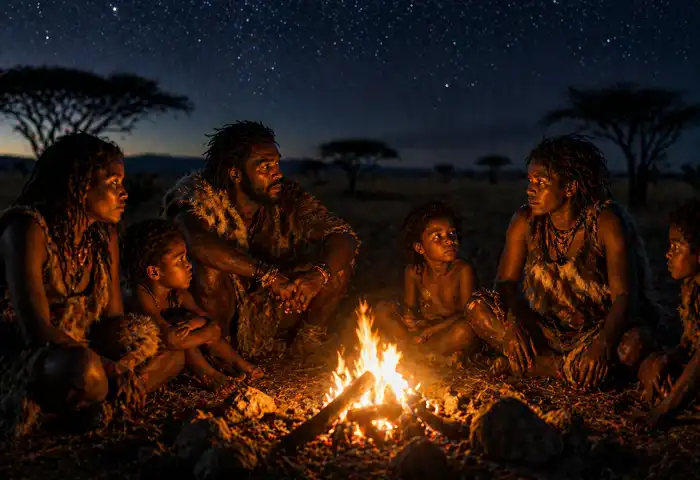
To understand why our social nature runs so deep, we need to travel back in time not hundreds of years, but hundreds of thousands.
For most of human evolutionary history, life was genuinely dangerous. Predators, disease, starvation, rival groups, and the brutal unpredictability of nature meant that solitary individuals faced almost certain death. In this environment, belonging to a group was not optional — it was survival. Those who were better at forming bonds, reading social cues, building trust, and maintaining cooperative relationships survived in greater numbers and passed their genes forward.
Over time, this relentless pressure sculpted our social nature into something extraordinary. The ancestors who were most skilled at reading faces and understanding emotions were better at detecting threats and building alliances. The ones who felt deep emotional pain when rejected from the group were motivated to repair relationships rather than drift away from safety. The children who formed the strongest attachments to caregivers were better fed, better protected, and more likely to survive childhood.
Every layer of our social instincts the joy of belonging, the sting of rejection, the warmth of affection, the drive to cooperate, the discomfort of loneliness can be traced back to evolutionary pressures that made social connection a matter of life and death.
This is why the social nature of humans feels so emotionally charged. Your nervous system does not distinguish between social rejection and physical danger in the way our rational minds might expect. Research by Dr. Naomi Eisenberger at UCLA has shown that social exclusion activates the same neural pathways as physical pain. Being left out of a group genuinely hurts not metaphorically, but neurologically because for most of human history, exclusion from the group meant death.
Understanding the evolutionary origins of our social nature also explains many behaviors that can seem puzzling in modern life. Why do people care so intensely about their reputation? Because reputation determined whether others would cooperate with you or ostracize you. Why does public humiliation feel so devastating? Because shame is a social regulation mechanism that signals a threat to one’s standing in the community. Why do we go to extraordinary lengths to help people we barely know? Because in small tribal societies, generosity built the networks of reciprocity that made survival possible.
Our social nature is ancient. It is adaptive. And it is still very much alive in every interaction we have today.
Part 3: The Science of Connection — Health, Happiness, and Longevity
If the evolutionary argument does not convince you of just how central social nature is to human life, the health science almost certainly will.
The research is staggering in its consistency. Across hundreds of studies conducted over the past five decades, one finding appears again and again: the quality and quantity of our social relationships is one of the strongest predictors of health, happiness, and longevity we have ever identified. It rivals diet, exercise, and even smoking in its predictive power.
A landmark meta-analysis published in PLOS Medicine, led by researcher Julianne Holt-Lunstad, analyzed data from over 300,000 participants across 148 studies. The conclusion was unambiguous: people with strong social relationships had a 50% greater likelihood of survival compared to those with weak or absent social ties. Loneliness, the researchers noted, is as dangerous to health as smoking 15 cigarettes a day.
Why does social connection affect physical health so profoundly? The mechanisms are multiple and fascinating:
The immune system responds to social signals. When people feel chronically lonely, their bodies enter a state of heightened inflammation the immune system behaves as though facing a constant physical threat. This chronic inflammation is linked to heart disease, cancer, diabetes, and accelerated aging. Belonging, by contrast, dampens this inflammatory response and supports immune function.
Stress hormones are regulated by relationships. The presence of a trusted social partner lowers cortisol levels, calms the fight-or-flight response, and reduces cardiovascular strain. Simply holding the hand of someone you love has been shown in studies to reduce the brain’s threat response to impending pain.
Oxytocin, the “bonding hormone,” has wide-ranging health effects. Released during moments of physical affection, eye contact, and emotional intimacy, oxytocin reduces blood pressure, promotes healing, supports digestion, and encourages feelings of trust and generosity. Our social nature is literally chemically reinforced by a hormone designed to make connection feel good and promote wellbeing.
Mental health is inseparable from social connection. Depression, anxiety, and other mental health conditions are consistently associated with social isolation. The therapeutic relationship — the bond between a patient and a therapist is one of the most powerful predictors of positive outcomes in mental health treatment, regardless of the specific method used. Belonging heals.
The profound link between our social nature and our physical and mental health is not coincidental. It is a direct consequence of millions of years of evolution shaping a biology in which social connection is equivalent to safety, nourishment, and life itself.
Part 4: Social Nature Across the Lifespan

Our social nature does not switch on at some arbitrary age and switch off at another. It is present from birth and remains active until death though it expresses itself in different ways across the arc of a human life.
Infancy and Early Childhood
The science of attachment, pioneered by John Bowlby and later expanded by Mary Ainsworth, reveals that the social nature of infants is breathtakingly sophisticated from the very beginning. Newborns prefer the sound of their mother’s voice over other voices a preference established while still in the womb. Within hours of birth, babies can imitate facial expressions. Within weeks, they engage in “proto-conversations,” taking turns vocalizing with caregivers in a dance that foreshadows all the social rituals of human life.
A securely attached child one who experiences consistent, responsive caregiving develops better emotional regulation, greater curiosity, stronger language skills, and more resilient social relationships throughout life. The quality of early attachment, shaped entirely by our social nature and the caregiving environment, leaves lasting marks on brain development, stress physiology, and personality.
Adolescence
The teenage years are often mischaracterized as a period of rebellion against relationships. In reality, adolescence is a period of intense social recalibration. Young people are not becoming less social — they are expanding their social worlds beyond the family circle, navigating peer hierarchies, romantic relationships, identity formation, and the complex social landscapes of school and community.
The adolescent brain is particularly sensitive to social reward and social rejection, which helps explain why social belonging feels so urgently important during these years. This is not immaturity it is the social nature asserting itself at a developmental stage specifically designed for expanding one’s relational world.
Adulthood and Aging
Adults who maintain rich social lives through friendships, romantic partnerships, family bonds, professional communities, and civic engagement consistently report higher levels of happiness and lower levels of stress than those who are socially isolated. The social nature remains a central driver of wellbeing throughout working life.
In older adults, social connection becomes even more critical. Research shows that socially active elderly people experience slower cognitive decline, lower rates of dementia, better physical health outcomes, and greater overall life satisfaction. Loneliness in old age, by contrast, accelerates cognitive deterioration and is associated with significantly higher mortality risk.
Across every stage of life, the story is the same: our social nature is not a phase. It is the persistent, core orientation of human existence.
Part 5: Social Nature in the Digital Age
The rise of digital technology and social media has introduced a fascinating new chapter in the story of human social nature. For the first time in history, we can maintain relationships across vast distances in real time, build communities with people who share our passions regardless of geography, and connect with strangers who become friends across cultural boundaries.
In some ways, technology has extended and amplified our social nature in remarkable ways. People find support groups, form meaningful friendships, and participate in communities online that they could never access in their physical geography. For isolated individuals — those living in rural areas, those with disabilities, those belonging to minority groups in their communities — digital connection can be genuinely life-saving.
Yet the digital age has also introduced new strains on our social nature. Research suggests that passive consumption of social media scrolling through curated highlight reels of other people’s lives without genuine interaction is associated with increased loneliness, envy, and reduced wellbeing. The social nature craves authentic, reciprocal connection. Watching others connect is not the same as connecting.
There is also growing concern about the quality of digital interaction versus face-to-face connection. Screen-based communication lacks many of the cues — touch, tone, facial micro-expressions, shared physical space — that our social nature relies upon to create deep bonds. Video calls are better than texts; texts are better than nothing. But none of them fully replicate the neurological richness of in-person presence.
The challenge of the digital age is to use technology to serve our social nature rather than substitute for it — to use digital tools to arrange real meetings, deepen existing bonds, and expand the reach of genuine community rather than to replace the irreplaceable experience of being truly present with other human beings.
Part 6: Nurturing Your Social Nature — Practical Strategies
Understanding the social nature of humans is one thing. Living in alignment with it is another. Here are evidence-based, practical strategies for nurturing your social nature in everyday life:
Prioritize depth over breadth. Research consistently shows that the quality of relationships matters more than quantity. A few deep, trusting friendships do more for your wellbeing than dozens of superficial acquaintances. Invest time and vulnerability in the relationships that matter most.
Be intentional about face-to-face time. Given the demands of modern life and the convenience of digital communication, in-person time requires deliberate scheduling. Treat it as non-negotiable, the way you would treat exercise or sleep.
Practice active listening. One of the most powerful gifts you can offer another person is genuine attention. Ask thoughtful questions. Resist the urge to redirect conversations to yourself. Make the person in front of you feel truly seen and heard.
Join communities of purpose. Shared activities and shared goals are among the most powerful generators of social bonds. Sports teams, volunteer organizations, religious communities, book clubs, professional associations any group organized around something meaningful creates the conditions for deep social connection.
Embrace small moments of connection. Social nature is nourished not only in grand gestures but in the accumulation of tiny moments a warm greeting to a neighbor, a genuine compliment to a colleague, a moment of eye contact with a stranger. These micro-connections add up.
Address loneliness proactively. Loneliness tends to become self-reinforcing because it creates cognitive biases that make social situations feel more threatening. If you feel chronically lonely, seek support — from a therapist, a community group, or by reaching out to someone you trust. Loneliness is not a character flaw; it is a signal from your social nature that something important needs attention.
Part 7: Building Societies That Honor Social Nature
Our social nature is not only a personal concern it is a political and social one. The societies we build, the policies we adopt, and the institutions we sustain either nourish or undermine the social bonds that keep human beings healthy and whole.
Urbanization, economic inequality, geographic mobility, the decline of civic institutions, the atomization of modern work — all of these trends have frayed the social fabric in measurable ways. Rates of loneliness have climbed significantly in many high-income countries over recent decades. The United Kingdom appointed a Minister for Loneliness in 2018. The United States Surgeon General issued an advisory on the loneliness epidemic in 2023. These are not responses to a soft, optional problem — they are responses to a public health crisis rooted in the neglect of human social nature.
Societies that invest in community infrastructure parks, libraries, community centers, walkable neighborhoods, civic organizations create environments where our social nature can flourish. Policies that reduce economic precarity, provide adequate parental leave, support mental health care, and protect workers from excessive isolation contribute to the conditions in which human bonds can form and deepen.
Honoring the social nature of humans at a societal level means recognizing that connection is not a luxury. It is a human need as fundamental as food, water, and shelter. A society that neglects this need does so at enormous cost — in mental illness, physical disease, social fragmentation, political polarization, and the erosion of the trust that makes collective life possible.
Conclusion
The social nature of human beings is one of the most beautiful, most durable, and most important truths about our species. It connects us to our deepest evolutionary past and speaks directly to the challenges of our present moment. It explains why a kind word can change a person’s day and why years of isolation can break a person’s spirit. It reminds us that beneath all the complexity of modern life, we are still the same creatures who huddled together around fires on the African savanna, sharing stories, raising children, mourning the dead, and celebrating the miraculous fact of being alive together.
Understanding our social nature is not merely interesting it is urgent. In an age of unprecedented technological connection and unprecedented social fragmentation, we need to actively choose to honor the relational core of what it means to be human. We need to build lives rich in genuine connection, support policies that knit communities together, and resist the cultural forces that tell us we are better off alone, self-sufficient, independent of others.
We are not. We never were. And the sooner we embrace that truth with humility, with gratitude, and with love — the better off we will all be.
Because in the end, the social nature of humans is not a limitation. It is our greatest strength. It is the force that built every city, composed every symphony, cured every disease, and raised every child into adulthood. It is what makes us, in the most profound sense, human.